
Table of Contents
Every month, your subscribers open a box, pull out a new jar, and add the old one to a growing pile under the sink. They notice. Some of them feel a little guilty about it. A few of them cancel because of it and never tell you why.
Refill models fix that pile, and the business case goes well beyond the environmental one. Refill subscription models can cut packaging costs dramatically while improving retention, because they turn sustainability into a tangible customer experience.
This guide covers why refills retain better, which categories they fit, the economics, and exactly how to set one up in Skio.
Why refill models outperform traditional subscriptions
Traditional subscription packaging creates recurring waste that customers see every cycle. A refill model removes that friction and replaces it with something better.
It creates a ritual. Refilling a container is a small physical act the subscriber performs every cycle. They take part in the subscription every cycle, and that participation builds habit.
It compounds savings. Lower per-order packaging and shipping costs add up over a subscriber’s lifetime. That margin funds the retention investments you already wanted to make.
It differentiates commodity categories. In spices, coffee, supplements, and beauty, products can look interchangeable on the shelf. A beautiful container sitting on a customer’s counter every day is a brand moment your competitors don’t get.
Refill models increase retention by making sustainability a repeatable customer action rather than a one-time packaging choice.
There’s also a quieter effect. Subscribers who’ve invested in your containers have a reason to keep refilling them. Canceling means the jar sits empty, or worse, gets filled with a competitor’s product.
Industries where refill models work best
Refills don’t fit every product. Refill models work best for high-frequency consumables where packaging is a significant cost. These categories fit that profile.
Category | Why refills fit | What the customer keeps |
|---|---|---|
Spices and seasonings | High frequency, small quantities, premium positioning | Glass jars or a branded spice rack |
Coffee and tea | Ritual-driven, daily use | A canister that becomes part of the morning routine |
Beauty and personal care | Refill pods cut bathroom clutter | A countertop-worthy dispenser or compact |
Supplements and vitamins | Monthly cadence, fixed daily dose | A branded dispenser that removes decision fatigue |
Cleaning products | Concentrates ship light and cheap | Durable spray bottles or dispensers |
If your product ships in packaging that costs a meaningful slice of COGS, and customers use it on a predictable cadence, a refill model is worth modeling.
Why the refill economics work
This is the section your CFO will read twice.
Packaging costs drop. A glass jar with a printed label costs several times more than a kraft refill pouch. Shipping the jar once and pouches after that changes your per-order packaging cost in a big way.
Shipping weight drops. Pouches are lighter than rigid containers, which lowers zone-based shipping costs on every renewal.
Perceived value goes up. Customers pay roughly the same price and get more product, because they’re no longer paying for a container every month.
You get a natural upsell. Sell a premium starter kit up front, then recurring refills. Extra containers become one-time add-ons.
Churn falls. Subscribers who own your containers are more likely to refill than cancel.
Refill models reduce per-order costs while maintaining or improving unit economics through higher retention. Brands that add refills as add-ons see the same dynamic Waterboy did when they 4X’d add-on revenue from subscriber emails. Small, recurring extras compound.
How to structure refill subscriptions in Skio
The setup is simpler than most teams expect. Here’s the architecture.
Use a two-SKU strategy. Create a starter kit product that includes the container and the first refill. Create a separate refill-only product. Two SKUs is enough. Resist the urge to build eight.
Configure selling plans so refills are the default recurring product. With selling plans, you can sell the starter kit as a one-time purchase and the refill as the recurring subscription at whatever frequency fits your product. This prevents the classic support nightmare of customers accidentally receiving a new container every month.
Track containers and refills as separate inventory. Set them up as distinct products in Shopify so you can forecast each one. The products tool walks through the setup.
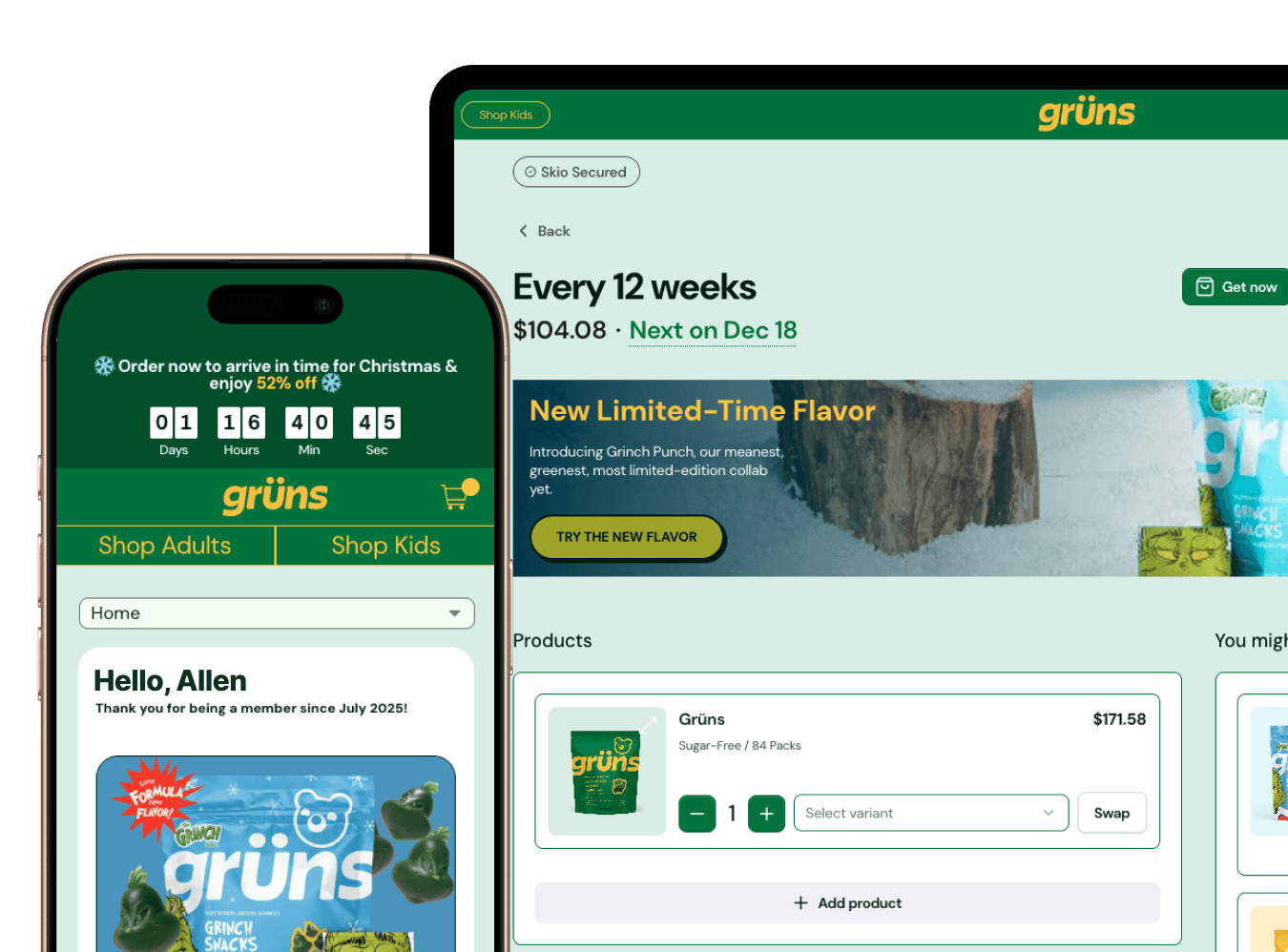
Let customers order extra containers on their own. Configure the customer portal experience so subscribers can add an extra container or switch between refill and full-product plans without opening a ticket.
Offer prepaid refill packs. A three-month or six-month prepaid refill bundle gives you cash up front and gives the subscriber a reason to stay committed.
Use separate SKUs for starter kits and refills, and configure selling plans so refills are the default recurring product.
The UX that makes refill models work
A refill model lives or dies on the experience. Get these details right.
Make the refill feel premium. Use metallized stand-up pouches or well-designed cartons. If the refill looks cheap, the whole subscription feels cheap.
Show people how to refill. Print a QR code on the pouch that links to a 15-second video. Nobody wants to spill turmeric all over the counter.
Invest in the container. It’s the brand artifact your customer sees every day. Spend money here and save it everywhere else.
Send refill-specific reminders. Customize email notifications so the pre-order message says “Your refill ships in 3 days” instead of a generic order reminder, with a “Running low?” nudge for customers who might want to ship early. Refill reminders are one flavor of a bigger topic, your pre-rebill communication strategy.
Build a recovery path. Some subscribers cancel because they started buying refills at a retail store. Offer to send extra containers or move them to a lower-frequency refill plan before they go.
What kills refill models and how to avoid it
Cheap starter containers. If the container looks disposable, customers treat it as disposable. Then you’re back to shipping containers every month.
Confusing SKU setup. When customers can accidentally subscribe to the starter kit, they get a new jar every cycle and email support about it. Keep refills as the only recurring option.
No container tracking. Customers lose track of how many containers they have. Make extra containers easy to buy as a one-time add-on.
Ignoring retail. Refill models pair well with a retail presence. Customers buy containers in stores and subscribe to refills online.
Overcomplicating the offer. “Starter kit” and “refill subscription” is all you need. Every extra SKU adds confusion.
Simplicity pays off in support volume too. SIMULATE learned the same lesson on login friction and hit zero login issues after migrating. Remove the confusing step and the tickets disappear with it.
Refill model launch checklist
Two distinct Shopify products, a starter kit SKU and a refill-only SKU.
Selling plans configured with the starter as one-time or low-frequency and the refill as the primary subscription frequency.
Customer portal settings with product swapping enabled and clear labels such as “Add Extra Container.”
Pre-order notification copy written for refills, such as “Your refill ships in 3 days.”
Support macros for “I need another container,” “My refill arrived damaged,” and “Switch me to the full product.”
An analytics segment that tracks refill-only subscribers separately, since their retention curve will look different.
What the refill math looks like for a spice brand
Here’s an illustrative example of how the numbers can move. Picture a spice brand shipping full glass jars every month.
Before. Every order ships new jars. Packaging runs a few dollars per order, and exit surveys keep mentioning “too many jars.”
The switch. First orders ship premium glass jars in a three-jar starter kit. Every order after that ships kraft refill pouches.
Packaging cost. Per-order packaging drops from jar-level cost to pouch-level cost, which can be a fraction of what it was.
AOV. The three-jar starter kit lifts first-order value compared with a single-jar subscription.
Support. “What do I do with all these jars?” tickets stop.
Retention. Subscribers who invested in a set of jars have a reason to keep filling them, and churn reasons tied to waste disappear from exit surveys.
Run the same model on your own catalog. Start with container cost divided by expected lifetime orders, then compare that to what you spend on packaging per order today.
Refills as add-ons to your core subscription
Refills don’t have to replace your core subscription. They can sit alongside it.
Take a coffee subscription that ships bags. Customers could add refill pouches for a travel canister as a recurring add-on. With one-time upsells, you can offer refill pouches at a discount right inside the subscription, and sell replacement containers as one-time purchases.
Watch the customers who buy both. They’re very likely your highest-LTV segment, and they’re telling you exactly what to build next.
Timing matters too. Promote refills in January, when sustainability resolutions peak, and again before summer travel season.
How to message refills without sounding preachy
Your subscribers don’t want a lecture. They want less clutter and a lower bill.
Lead with convenience. “Refills take up way less space in your pantry” beats a paragraph about landfills.
Show the math. “Save $3 per order” lands harder than “save the planet.”
Use customer language. “Less packaging to deal with” resonates more than “reduced carbon footprint.”
Make it visual. A side-by-side photo of 12 jars versus 1 jar and 11 pouches does the selling for you.
Avoid greenwashing. If your pouches aren’t actually recyclable or compostable, don’t make sustainability claims. Lead with cost and convenience instead.
FAQ
What products work best for refill subscription models?
High-frequency consumables where packaging is a significant cost. Spices, coffee, supplements, beauty products, and cleaning supplies all fit, especially when customers value a premium container but don’t need a new one every month.
How do you prevent customers from accidentally ordering containers every month?
Use separate SKUs for starter kits and refills, and configure selling plans so the refill is the default recurring product. Clear labels in the customer portal and pre-order notifications help too.
Do refill models actually improve retention?
They tend to. Customers who invest in containers are less likely to cancel, and refills remove the “too much packaging” complaint that drives some cancellations. Track refill subscribers as their own segment to measure the effect on your brand.
What’s the minimum subscriber count to make refill packaging cost-effective?
It depends on your container cost. Divide container cost by expected subscriber lifetime orders, then compare against your current per-order packaging cost. Simple pouches break even quickly, while custom containers need more scale.
Can you sell refills in retail and subscriptions online?
Yes, and it’s an ideal setup. Retail drives container purchases and discovery, while online subscriptions drive recurring refill revenue.
How do you handle customers who lose or break their containers?
Sell replacement containers as one-time purchases in your customer portal. Price them at cost or a slight markup. Treat it as a retention play and keep the margin thin.
The container is the part customers keep. Make it worth keeping, and the refills sell themselves.