
Table of Contents
Your portal is where subscribers live, and it's where most of your support tickets are born. When the portal is slow, clunky, or stuck on a version that can't ship new features, every skip request and payment update becomes an email your team has to answer by hand. At some point the workarounds cost more than the upgrade. That point usually arrives around the time support tickets cross 200 a month or churn analysis starts pointing at UX friction as the top reason people leave.
Portal upgrades reduce support tickets 40 to 60 percent when you migrate subscribers gradually, test payment flows first, and communicate changes 7 days ahead. The catch is that all three of those have to happen. Skip the testing and you get failed renewals. Skip the communication and you get a support pile-up. Do them in order and the upgrade pays for itself inside a quarter.
Why subscription brands upgrade their portal
The trigger is almost always support volume. A legacy portal quietly taxes your team: every task that should take the customer one click takes five, so they give up and email instead. Brands that move to a modern portal typically see support drop 40 to 60 percent, churn ease as self-service stops being a fight, and a real reduction in the labor hours a clunky portal was silently burning.
The other trigger is feature velocity. When your portal can't support cancel flows, upsells, or loyalty because it's built on an architecture that stopped shipping, the technical debt compounds. You're not just paying in support hours, you're paying in the growth features you can't launch.
The real cost of staying on a legacy portal
Legacy portals cost more than the line item suggests. There's the direct support labor: agents manually processing skips, swaps, and address changes that a modern portal absorbs on its own. There's the churn tax from UX friction, the subscribers who cancel because changing their order is harder than quitting. And there's the opportunity cost, the features you can't ship and the upsell revenue you never capture because the portal can't support it.
Pre-upgrade checklist: what to audit before you migrate
Do the boring work first. Before you touch anything, audit these:
Portal usage data. Which features actually get used, and which don't. This tells you what to prioritize in the new portal.
Custom workflows and edge cases. Document the weird ones now: prepaid, gift subscriptions, multi-frequency setups. These break first if you don't map them.
Subscriber data integrity. Export your records and confirm they're clean before migration, not after.
Every integration that touches the portal. Klaviyo, Gorgias, custom APIs. Map them so nothing silently disconnects.
High-risk segments. High-LTV, prepaid, and enterprise subscribers are the ones you least want to disrupt. Know who they are before you flip anything.
Support ticket themes. Your ticket history is a punch list of what to fix in the new portal.
The subscription management docs cover the data side of this in more detail.
Migration strategy: phased rollout vs. big bang
Phased rollouts to 5 to 10 percent of subscribers reduce risk and let you fix issues before full migration. Roll out to a small cohort, watch your metrics, then expand. Segment the rollout however de-risks it best: by cohort, by subscription type, or by LTV so your most valuable subscribers move last, after you've ironed out the problems.
A big-bang migration works when your catalog is simple and your subscriber base is small enough that phasing adds more overhead than safety. Either way, set your success metrics before you flip the switch, and have a rollback plan ready for if the numbers tank.
Testing protocol: what to validate before launch
Payment flows are the thing that breaks, and a broken payment flow means failed renewals and immediate churn. Test these before launch, every one:
Payment method updates, first and most thoroughly (updating and adding credit cards)
Address changes and validation
Subscription swaps and frequency changes
Cancel flows and pause functionality
Mobile responsiveness, since the majority of portal traffic is on a phone
Login flows, including passwordless and native Shopify
One-time add-ons and upsells
The edge cases you documented: prepaid renewals, gift subscriptions, multi-subscription households
Test payment updates, address changes, swaps, cancellations, and mobile UX before launching any portal upgrade. The one that gets skipped is always mobile, and mobile is where most of your subscribers actually are.
Communicating the upgrade to subscribers
Notify subscribers 7 days before major portal changes, focusing on benefits like faster load times and easier payment updates. Tell them a week out for anything major, 24 hours for minor changes. Lead with what improves for them, not the technical detail of what you changed. Use every channel you've got: email, SMS, an in-portal banner, an updated FAQ.
Expect a few "I liked the old one better" replies. That's normal. Set up a feedback loop so early issues surface fast, and keep the tone celebratory rather than anxious.
Day-of-launch checklist
Launch day is a monitoring job. Watch login success rate, error rates, and support ticket volume in real time. Keep your dev team on standby for the first 48 hours. Prepare canned responses for the questions you know are coming, set up alerts for payment processing errors, and keep the rollback plan within reach. Document everything that goes wrong, because next migration will thank you.
Post-launch: measuring success
Track support tickets, login success rate, churn, and time-to-complete tasks for 60 days post-launch to measure portal upgrade success. Wait the full 60 days before drawing conclusions on churn, since it takes that long to reach statistical significance. Track the time it takes a customer to complete common tasks like a payment update or address change, watch your CSAT or NPS, and if you added upsell features, measure their conversion. Then set a quarterly review to keep assessing ROI. Skio's analytics is where most of this lives.
Common upgrade mistakes (and how to avoid them)
The biggest portal upgrade mistake is insufficient payment flow testing, which causes failed renewals and immediate churn spikes. After that, the usual suspects: changing too much at once and overwhelming both subscribers and support, poor communication timing, no rollback plan, ignoring the mobile experience, and breaking existing integrations without warning your partners. Every one of these is avoidable with the audit and testing steps above.
What makes Skio's portal upgrade different
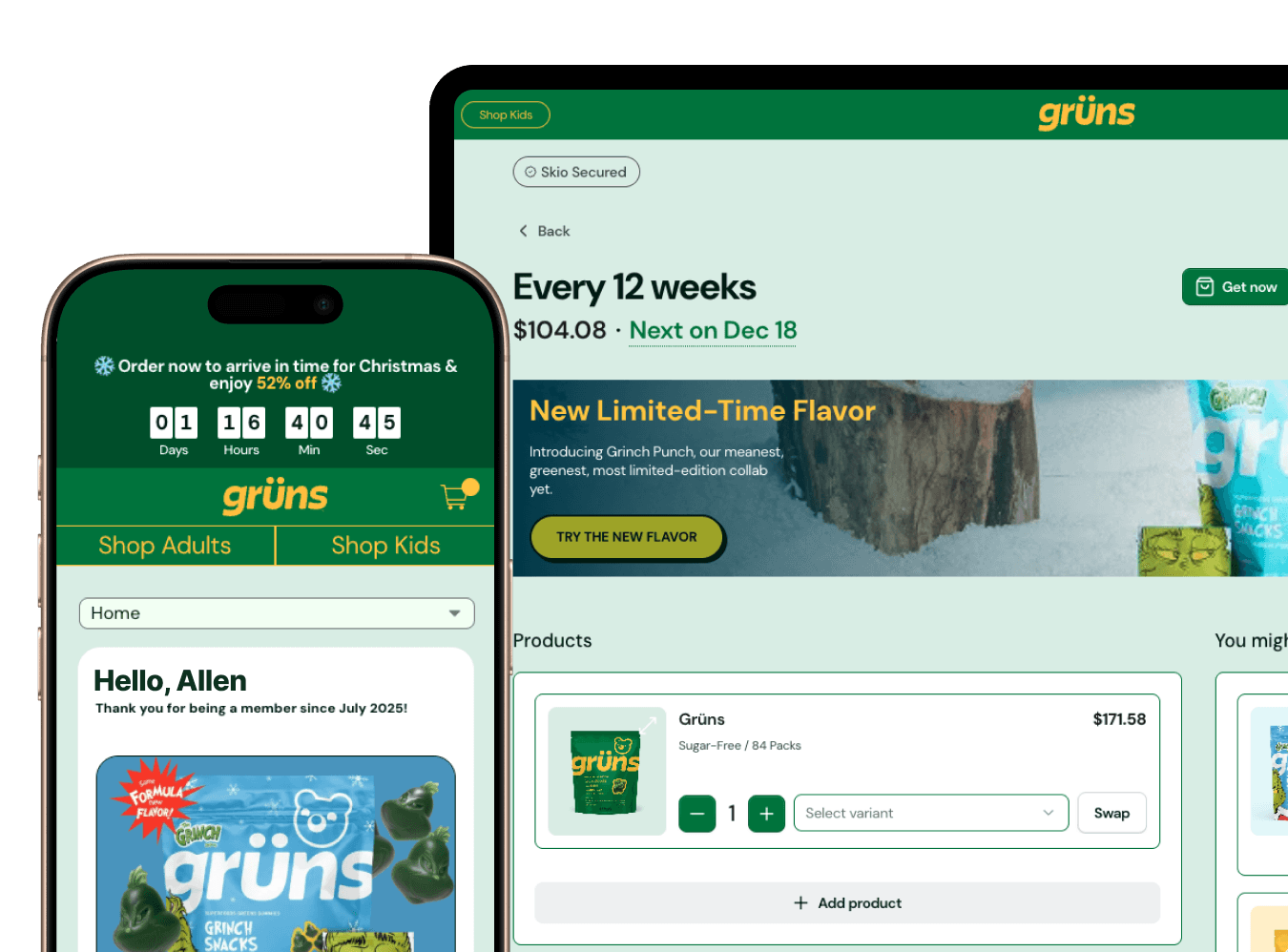
Skio handles the migration itself: data integrity, testing, and rollout, rather than handing you documentation and wishing you luck. The Customer Portal v3 is mobile-first rather than mobile-responsive, and it ships with the features that cut support on their own. Passwordless login removes the single biggest source of post-upgrade tickets, since customers get a 4-digit code by SMS or email instead of a password to reset. Inline editing collapses common tasks from several clicks to one. And because customization is no-code, matching your brand doesn't require dev resources. The retention tools, cancel flows, upsells, and loyalty, are built in rather than bolted on.
When to upgrade vs. when to wait
Upgrade portals during low-volume periods with dev support available, typically post-peak season and before major growth initiatives. Upgrade now if support tickets are overwhelming, churn is climbing, or you're blocked from launching features you need. Wait if you're mid-peak-season, about to launch a major product, or short-staffed. The best window is post-peak and pre-growth-push, when you have the dev bandwidth to do it right.
FAQ
How long does a customer portal upgrade take?
Phased rollouts run 2 to 4 weeks. Full migrations with testing take 4 to 8 weeks depending on catalog complexity and how many integrations are involved.
Will upgrading my portal cause subscriber churn?
A well-executed upgrade reduces churn by removing UX friction. Churn spikes come from poor communication or broken payment flows, which is exactly why the testing and notification steps matter.
Can I keep my old portal design in the new system?
Modern portals offer extensive customization. You can match your brand colors, fonts, and layout while gaining the better functionality and mobile experience underneath.
What happens if subscribers can't log in after the upgrade?
Passwordless login eliminates most login problems on its own. Keep support ready with manual login assistance for the first 48 hours as a backstop.
Do I need developer resources to upgrade my portal?
Skio handles portal upgrades without merchant dev resources. Custom integrations or advanced customizations may need a technical review, but the standard upgrade doesn't.
How do I measure portal upgrade ROI?
Compare support ticket volume, churn rate, and feature adoption before and after launch. Most brands see positive ROI within 90 days from support savings alone.
The bottom line
A portal upgrade isn't risky because upgrades are hard. It's risky when you skip the audit, skip the payment testing, or spring it on subscribers with no warning. Do those three things in order and you get the support drop, the churn improvement, and the feature velocity without the launch-day fire drill.