
Table of Contents
Fixed-price build-a-box programs look great until the COGS report catches up, usually about 90 days after launch. The problem is structural. When you offer a flat discount on a custom box, you're handing customers a reason to fill it with your most expensive SKUs. A 25 percent discount on a $60 box costs you a lot more when they pick six $12 items than when they pick six $8 items, and they will pick the $12 items every time.
Volume discounts protect margins by tying discount depth to quantity purchased, not product selection, preventing customers from cherry-picking high-cost items. That single design choice is the difference between a build-a-box program that scales and one that quietly tanks your contribution margin.
Why CFOs kill fixed-price build-a-box programs
Fixed bundle pricing creates adverse selection. Customers maximize the high-cost items and minimize the low-cost fillers, which is rational for them and expensive for you. The flat discount was calibrated for an average basket that customers have every incentive to beat. Most brands don't catch it at launch. They catch it a quarter later when someone finally runs contribution margin by box and the number is lower than anyone modeled.
Fixed-price build-a-box programs erode margins when customers select high-cost products at flat discount rates designed for average basket values.
The margin math: fixed bundles vs. dynamic volume pricing
The fix is to make the discount a function of quantity, not mix. Set up the comparison as a real P&L, not a gross-margin hand-wave. Take a 3-item box, a 6-item box, and a 12-item box, and run each against varying COGS scenarios. Include contribution margin, which means factoring in the pick-and-pack cost of a custom box, not just gross margin. When the discount scales with how many units the customer buys rather than which units, the economics stay predictable regardless of what they select.
How volume discounts protect margin while increasing AOV
Volume pricing scales the discount with quantity, so the customer still gets customization and savings, but the math stays under your control. The discount is tied to the number of units, not the identity of the units, which is what prevents cherry-picking. And it works for both subscription and one-time orders, so you capture recurring revenue without recurring margin bleed. You can also exclude specific high-cost SKUs from the discount entirely if a few items would break the model. Skio's volume discount tools handle the exclusion logic.
Three volume discount structures that work
Quantity-based tiers. 3 items for 10 percent off, 6 items for 15 percent, 12 items for 20 percent. Cleanest when your product costs are relatively uniform.
Price-threshold tiers. Spend $50 for 10 percent off, $100 for 15 percent, $150 for 20 percent. The better choice when SKU costs vary widely, since the threshold protects margin on its own. Set these up with price-based volume discounts.
Hybrid. Base the discount on quantity, then add a bonus tier for hitting a dollar threshold. Useful for wide catalogs with mixed price points.
The deciding factor is your product cost variance. Uniform costs favor quantity tiers. Wide variance favors price thresholds.
Setting volume tiers that drive behavior without killing margin
Set volume tiers just above current purchase behavior to drive incremental units while keeping discount depth within contribution margin targets. Start from your contribution margin floor and work up. Tier 1 should sit just above your current average cart size, so it pulls incremental units without rewarding behavior customers already have. Tier 2 should target a 40 to 50 percent increase in units, which is your AOV sweet spot. Tier 3 is your hero tier: aggressive enough to feel like a genuine win, rare enough that it doesn't drag down blended margin.
The subscription advantage: predictable revenue, protected margins
Subscription volume discounts lock in recurring revenue at a known margin, which changes the discount equation entirely. A one-time volume deal is a margin gamble. A subscription volume deal is margin planning. Because you're optimizing for lifetime value, you can front-load the savings and recover margin over subsequent cycles, then work out the payback period explicitly: how many cycles it takes to recover an aggressive first-order discount. That's a calculation the Economic Buyer will actually respect, because it treats the discount as an investment with a return schedule rather than a giveaway.
Build-a-box execution: Skio's volume discount + product picker
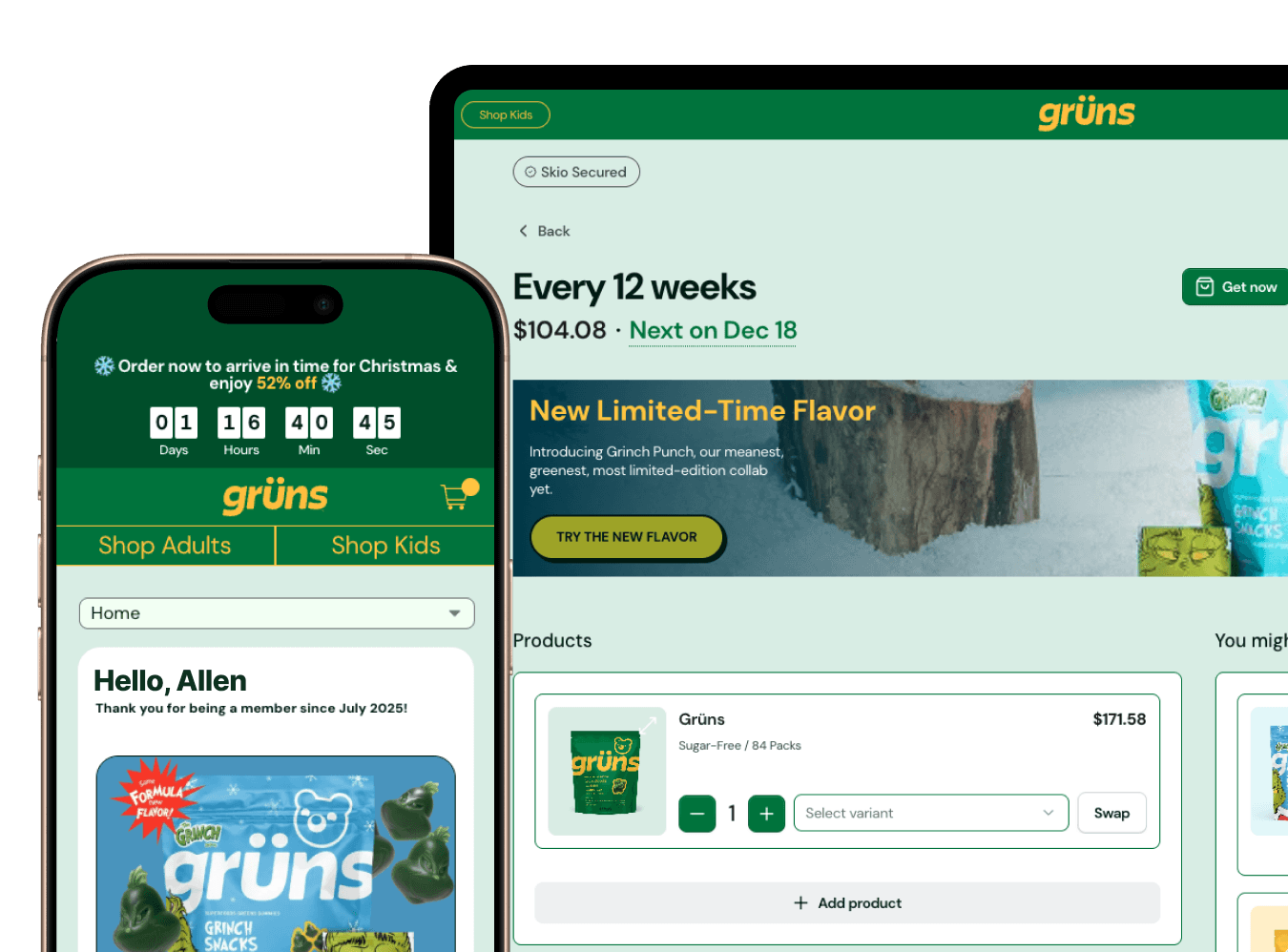
Operationally, the discounts apply automatically as customers add products to their box, with real-time calculation in the cart so there's no surprise at checkout. You can restrict specific SKUs from discounts where the cost math demands it. Subscription frequency options layer on top, so the customer builds their box and picks a cadence in the same flow. And it works against your existing catalog rather than requiring a separate set of bundle SKUs to manage.
Operational complexity: the hidden cost of custom boxes
Custom box programs increase fulfillment costs 15 to 30 percent through complex pick/pack workflows and inventory requirements that must be factored into margin planning. This is the cost most brands ignore until it's too late. Custom boxes mean custom pick-and-pack, which is slower and more error-prone than a fixed bundle. Every SKU has to be available or a substitution damages satisfaction. Returns get messier, since "I didn't like one item" becomes a partial-refund scenario that eats margin. Run an operational readiness check before launch: can your 3PL actually handle custom pack at your volume, and have you priced that into the model?
When volume discounts beat fixed bundles (and when they don't)
Volume discounts win when you have high product cost variance, a wide SKU catalog, and a subscription model. Fixed bundles win when you have a narrow product line, consistent COGS, and a one-time gift market. There's also a hybrid worth considering: fixed starter bundles paired with volume-discount add-ons. Map your own situation against those characteristics rather than assuming one model fits. The choosing-between guide lays out the decision in more detail.
Tracking what matters: KPIs for build-a-box economics
Watch blended contribution margin by tier, not just gross margin. Track AOV lift against single-product purchases, discount penetration by tier so you know how many customers hit each threshold, and the product mix inside boxes so you can see whether customers are cherry-picking high-cost items. Watch subscription retention by box size to learn whether bigger boxes stick better, and keep an eye on 3PL cost per order versus standard fulfillment, since that's the hidden margin killer. Skio's Products Dashboard surfaces most of these.
Migration path: from fixed bundles to volume discounts
Don't pull the rug on existing subscribers. Grandfather them at current pricing, then test volume discounts with new customers first to validate your margin assumptions before rolling wider. Offer a migration incentive for existing subscribers who want to move ("upgrade your box, unlock new pricing tiers"), and monitor churn through the transition, since some customers anchored to old pricing will leave regardless. Bulk operations handle the transition at scale without manual subscription editing.
FAQ
How do volume discounts protect margins better than fixed bundle pricing?
Volume discounts tie savings to quantity purchased, not product mix, so customers can't cherry-pick high-cost items at a flat discount rate. Margin stays predictable regardless of which products they select.
What's the ideal volume discount tier structure for subscription boxes?
Set Tier 1 just above current average cart size, Tier 2 at 40 to 50 percent higher volume, and Tier 3 as an aggressive hero tier. Each tier's discount should stay within contribution margin targets while driving incremental purchase behavior.
Should I use quantity-based or price-based volume discounts for build-a-box?
Use quantity-based tiers when product costs are consistent. Use price-based tiers when product costs vary significantly. Hybrid models work best for wide catalogs with mixed price points.
How do I calculate the right discount depth for each volume tier?
Start with your contribution margin floor, including pick-and-pack costs, then set discounts that preserve minimum acceptable margin at each tier. For subscriptions, factor in LTV, since front-loaded discounts recover over multiple billing cycles.
What operational costs should I factor into build-a-box margin calculations?
Include 15 to 30 percent higher 3PL costs for custom pick-and-pack, inventory carrying costs for full SKU availability, CS overhead for partial returns, and subscription management complexity. These hidden costs often erase an apparent margin advantage.
Can I restrict certain high-cost products from volume discounts?
Yes. Skio's volume discount tools let you exclude specific SKUs or cap discount percentages on high-cost items while still offering tiered pricing across the rest of your catalog.
The bottom line
Build-a-box isn't a margin problem, it's a pricing-design problem. Tie the discount to quantity, model contribution margin instead of gross margin, price in the real 3PL cost, and you get the customization customers want on economics you can defend to your CFO.