
Table of Contents
Search "customizable subscription box" and the entire first page is packaging companies trying to sell you cardboard. Nobody's actually answering the question you're asking, which is: should I let customers build their own box, and if so, how do I build it without torching my fulfillment team? Let's fix that.
There are two ways to do Build-a-Box, and picking the wrong one either caps your revenue or buries your operations. Here's how to choose.
What Static Build-a-Box actually is
Static Build-a-Box uses pre-configured bundles. The customer picks from fixed combinations you've set up, like "6-pack, choose 3 flavors, 2 of each." Each combination maps to a Shopify product variant, so there's no custom logic required. Inventory tracking, fulfillment, and analytics all work out of the box.
The trade-off is flexibility. Customers choose from your curated sets rather than building from scratch. In return, you launch fast and manage it without an engineering team babysitting it. Static is the right call when you've got 8 to 20 SKUs, straightforward fulfillment, and a need to get live quickly. Setup runs through the Static Build-a-Box guide.
What Dynamic Build-a-Box actually is
Dynamic Build-a-Box lets customers pick individual products and quantities. "Build your 12-pack, choose any 12 items." This is the experience customers love, and it tends to lift AOV because people add more when they control the mix. Build-a-Box is a well-documented AOV driver for exactly this reason, since a customer curating their own box behaves differently from one accepting a fixed pack.
The cost is complexity. Dynamic requires real backend infrastructure: inventory checks per item, subscription line-level management, and a clean UX so customers don't abandon a half-built box. It's worth it when you've got 20 or more SKUs, an ops team that can handle the load, and customers who expect customization. The Dynamic Build-a-Box v3 guide covers the setup.
The decision framework
Here's the short version of which model fits where.
Criteria | Static | Dynamic |
|---|---|---|
SKU count | Under 20 | 20+ |
Launch speed | Weeks | Longer setup |
AOV impact | Solid baseline | 15-30% higher |
Fulfillment complexity | Low | High |
Inventory forecasting | Simpler | Harder |
Support load | Lower | Higher if misconfigured |
Best for stage | Pre-revenue to early growth | Scaling past $1M ARR |
Choose Static if you need to launch fast with a tighter catalog. Choose Dynamic if you've got the SKU range and the operational capacity to support line-level customization without drowning.
Who uses Static and why it works
Static isn't the boring choice. It's the smart starting move for a lot of brands. Supplement brands with 8 to 12 SKUs convert faster with "pick 3 products" bundles than with an overwhelming build-from-scratch flow. Coffee roasters use "pick 3 bags" boxes to cut decision fatigue and improve retention. Gains In Bulk 5x'd their subscriber base to 7,800 in three months with clean fulfillment the whole way. You can offer 5 to 10 well-curated bundles that feel premium without ever touching Dynamic.
Who uses Dynamic and when it pays off
Dynamic earns its complexity for the right catalog. Snack brands with 30-plus SKUs let customers mix flavors, sizes, and dietary preferences, which is the whole appeal. Protein and meat brands use "build your 10-lb box" to push AOV above what a static pack would hit. Waterboy 4x'd their add-on revenue leaning into a customer-controlled, add-what-you-want experience. The catch is that Dynamic demands investment in inventory management, line-level control, and a UX clean enough to prevent cart abandonment. Get those right and it pays off. Get them wrong and it generates support tickets.
Start Static, graduate to Dynamic
For most brands the right path is sequential. Launch Static first to validate demand, learn what customers actually want, and build revenue. Upgrade to Dynamic when you hit $500K to $1M ARR, your catalog crosses 20 SKUs, and your ops team can absorb the complexity. Skio's Dynamic Build-a-Box v3 even lets you run both models at once, so you can test before committing fully. A nice hybrid move is offering Static bundles to new customers for lower friction and Dynamic to repeat subscribers for higher AOV.
Mistakes that kill Build-a-Box programs
A few ways brands sabotage themselves:
Building Dynamic first. Over-engineering before product-market fit. Launch Static, iterate, then add complexity.
Too many choices. A Dynamic builder with 50-plus ungrouped SKUs creates decision paralysis. Curate or use sections.
Ignoring fulfillment. A box that can't be picked efficiently means an angry warehouse and missed ship dates.
No inventory rules. Letting customers build boxes with out-of-stock items is a support nightmare. Use real-time stock checks.
Skipping mobile. The majority of traffic is mobile. If the builder doesn't work cleanly on a phone, you're losing conversions you already paid to acquire. The effect is real and measurable: Just Ingredients moved "Add Product" above the fold on mobile and it contributed to a 121 percent jump in add-on revenue.
How Skio's Build-a-Box is different
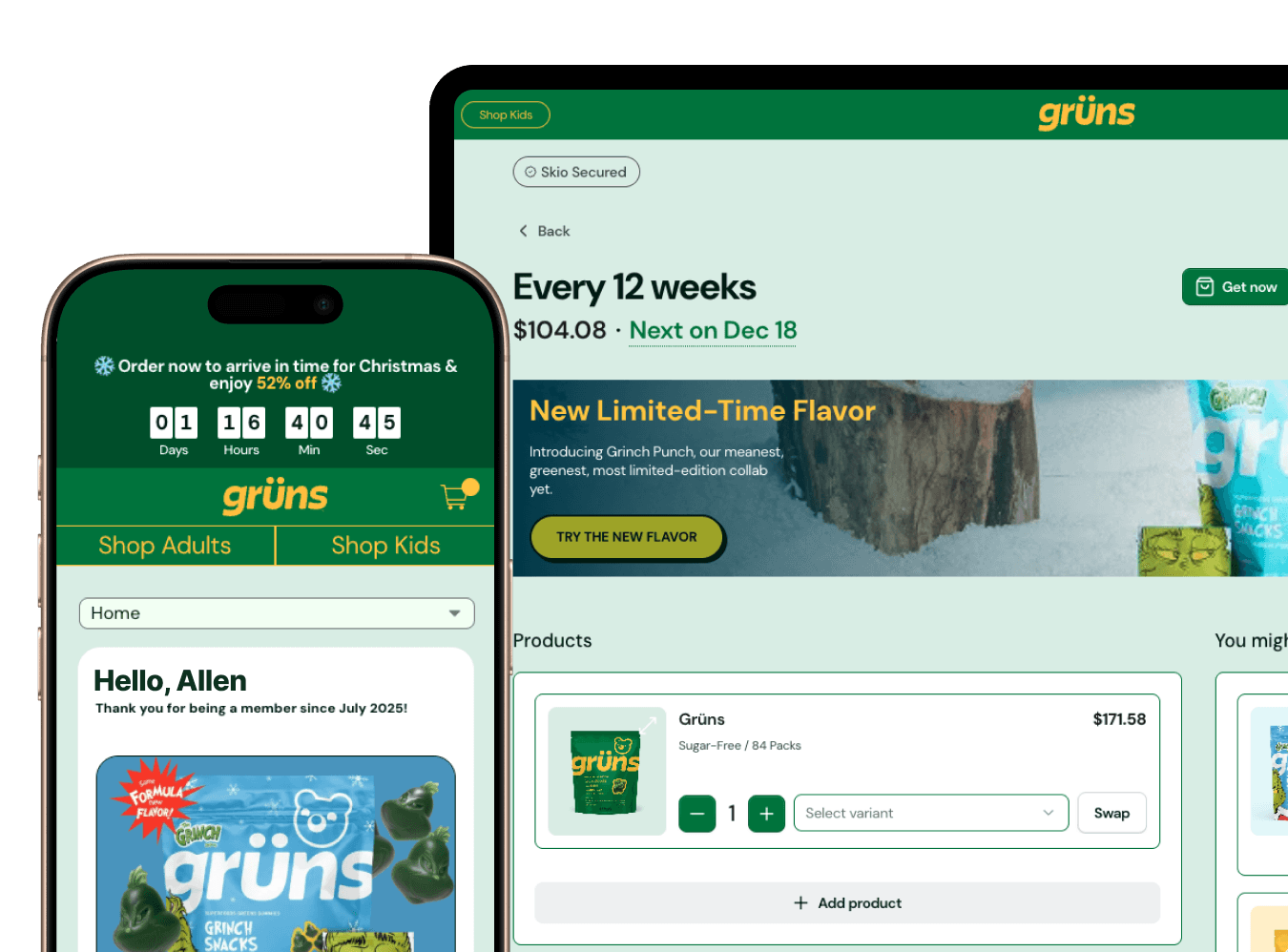
Static maps to Shopify product variants, so it works with your existing fulfillment with no custom code. Dynamic v3 gives you native subscription line-level control, so customers can swap, add, or remove items per delivery. Both integrate with the Customer Portal, which means subscribers edit their own boxes without opening a ticket. Real-time inventory sync stops anyone from adding an out-of-stock item. And because the builder is subscription-native, you don't get the broken logic that third-party bundle apps produce when a customer actually tries to subscribe. The Build-a-Box overview and subscription management docs cover the operational side.
Before you launch either model
Make sure you've got an inventory system that tracks bundles for Static or individual SKUs for Dynamic, a fulfillment process that can pick multi-SKU orders efficiently, support ready for "how do I change my box" questions, and analytics tracking AOV by box type and swap patterns. For Dynamic specifically, you need a subscription tool that handles line-level edits natively, which Skio does.