
Table of Contents
Shopify gift cards work fine on one-time purchases. On subscription orders, they silently fail — and your customer support queue pays the price. If you're running a loyalty program that rewards subscribers with gift cards, you're creating a problem you didn't know you signed up for.
Here's exactly why it happens, and what actually works instead.
The Loyalty Program Promise vs. the Shopify Reality
The pitch from your loyalty vendor was simple: customers earn rewards, customers redeem rewards, customers feel good, customers stay. Gift cards are the most intuitive reward format. Customers understand them. They feel like real money.
So you set it up. Subscribers earn $20 gift cards when they hit milestones. A customer who's been subscribing for six months finally earns one. She goes to her next recurring order, tries to apply the gift card code — and nothing happens.
Then she emails your support team.
"We were getting tickets every week from subscribers who couldn't use the gift cards they earned. The CX team kept having to explain why a reward they earned wasn't usable on the orders they placed most often. It was embarrassing." — Retention Manager at an 8-figure DTC brand
That ticket isn't an edge case. For brands running active loyalty programs, this happens 50+ times a month. The same explanation, over and over. The same frustrated customer — the one who's been with you long enough to earn a meaningful reward — learning that the reward doesn't work where they shop most.
Shopify gift cards work on one-time purchases but fail on subscriptions because the API doesn't support them as recurring payment methods.
This isn't a bug your dev team can fix. It's architecture.
Why Gift Card Redemption Fails on Subscriptions
Understanding why this happens matters, because once you see the architecture, you understand why no workaround actually solves it.
Shopify subscriptions run on the Subscription Contract API. When a customer subscribes, Shopify vaults their payment method: credit card, Shop Pay, PayPal. That vaulted instrument is what gets charged on every recurring order automatically, without the customer needing to be present at checkout.
Gift cards don't work this way. They're one-time codes — a string of characters that represents a balance. They can't be saved as vaulted payment instruments. The subscriptionContractUpdate mutation that manages recurring billing doesn't accept gift cards as a payment method type.
The specific failure points:
Gift cards are one-time codes, not vaulted payment instruments
Shopify's subscription infrastructure requires a saved payment method for recurring charges
Even when a customer applies a gift card at initial checkout, the balance doesn't carry to subsequent recurring orders
The gift card code can't be attached to a subscription contract as a reusable payment source
Gift card balances aren't queryable in the context of subscription billing — the two systems don't communicate
Gift cards can't be saved as recurring payment methods in Shopify's subscription infrastructure.
This isn't a Skio limitation. Every subscription platform built on Shopify hits the same wall. The limitation lives at the Shopify API layer, and no amount of custom development makes gift cards work reliably on recurring orders. Platforms that claim otherwise are either using fragile workarounds or restricting gift card redemption to the initial order only — which isn't the same thing.
What This Breaks in Your Customer Experience
The technical limitation has a human cost, and it lands squarely on your most loyal customers.
Think about who earns gift card rewards. Not new customers. The people who've been buying from you for months, who chose a subscription because they trust you, who've accumulated enough spend to hit a reward threshold. These are your VIPs.
When they can't redeem their reward, a few things happen:
They contact support. Your CX team now has to explain a Shopify API limitation as if it's a policy decision.
They feel penalized for being subscribers. The customers generating the most predictable revenue are the ones who can't access the benefit.
Trust erodes. The loyalty program promised something it can't deliver — and that's a broken promise even when the reason is technical.
Churn risk goes up. A frustrated VIP who earned a reward they can't use is much closer to canceling than one who never encountered the problem.
Gift card limitations make subscribers feel like second-class customers who can't use the rewards they earned.
Your loyalty program was supposed to reduce churn. Instead, it's generating support tickets and frustrating the customers you most need to keep.
The Workarounds (And Why They All Fall Apart)
When teams discover the gift card problem, they usually try to engineer around it. None of the common approaches work at scale.
Manual discount codes: Your CX team generates a one-time discount code equivalent to the gift card value and sends it to the customer. The customer manually enters the code in their subscription portal — if your portal even supports that. The code works once. When the next order processes automatically, the code is gone. Repeat for every reward, every customer, every month.
Pause subscription, place one-time order: Tell the customer to pause their subscription, place a one-time order using the gift card, then reactivate. This asks subscribers to complete three extra steps to use a reward they earned. Most won't bother. The ones who do are annoyed.
Support team manually applies credit: Your CX team fields the ticket, calculates the equivalent discount, and manually adjusts the order. This doesn't scale past 10 tickets a month. At 50+ tickets, it's a part-time job.
Restrict gift cards to one-time orders only: Update your loyalty program messaging to tell subscribers they can only use gift cards on non-subscription purchases. Technically accurate. Deeply unsatisfying. You're telling your best customers that their rewards don't work on the orders they place most often.
Every one of these creates more work for your team and a worse experience for customers. None of them fix the underlying problem.
Why Store Credits Solve This
Store credits work on subscriptions for a straightforward reason: they apply at checkout as order-level discounts, not as saved payment instruments.
When a customer has a credit balance, it shows up at checkout as a discount applied to the order total. The subscription's actual payment method — the vaulted credit card — still processes the remaining balance. Shopify has no problem with this. Credits aren't trying to replace the payment method; they're reducing the amount the payment method needs to cover.
This means:
Credits work on the initial subscription checkout
Credits work on every recurring order
Customers see their balance before checkout and can apply it with one click
No manual codes, no support tickets, no workarounds
Credits stack with subscription discounts automatically, depending on how you configure it
Store credits apply at checkout as order-level discounts, so they work on subscriptions without needing to be saved as payment methods.
This is how Skio Loyalty credits were built — not as a loyalty bolt-on that happened to work on subscriptions, but as a system designed from the start to solve the exact problem gift cards can't. When you're thinking through choosing between store credits and points as your loyalty mechanic, subscription compatibility alone often settles it.
How Skio's Store Credit System Works for Subscription Brands
The implementation details are what make credits actually work rather than just theoretically work.
Earn rules are fully configurable. Customers earn credits based on actions you define: subscription purchases, one-time purchases, referrals, reviews, hitting order milestones. You control the earn rate for each action type.
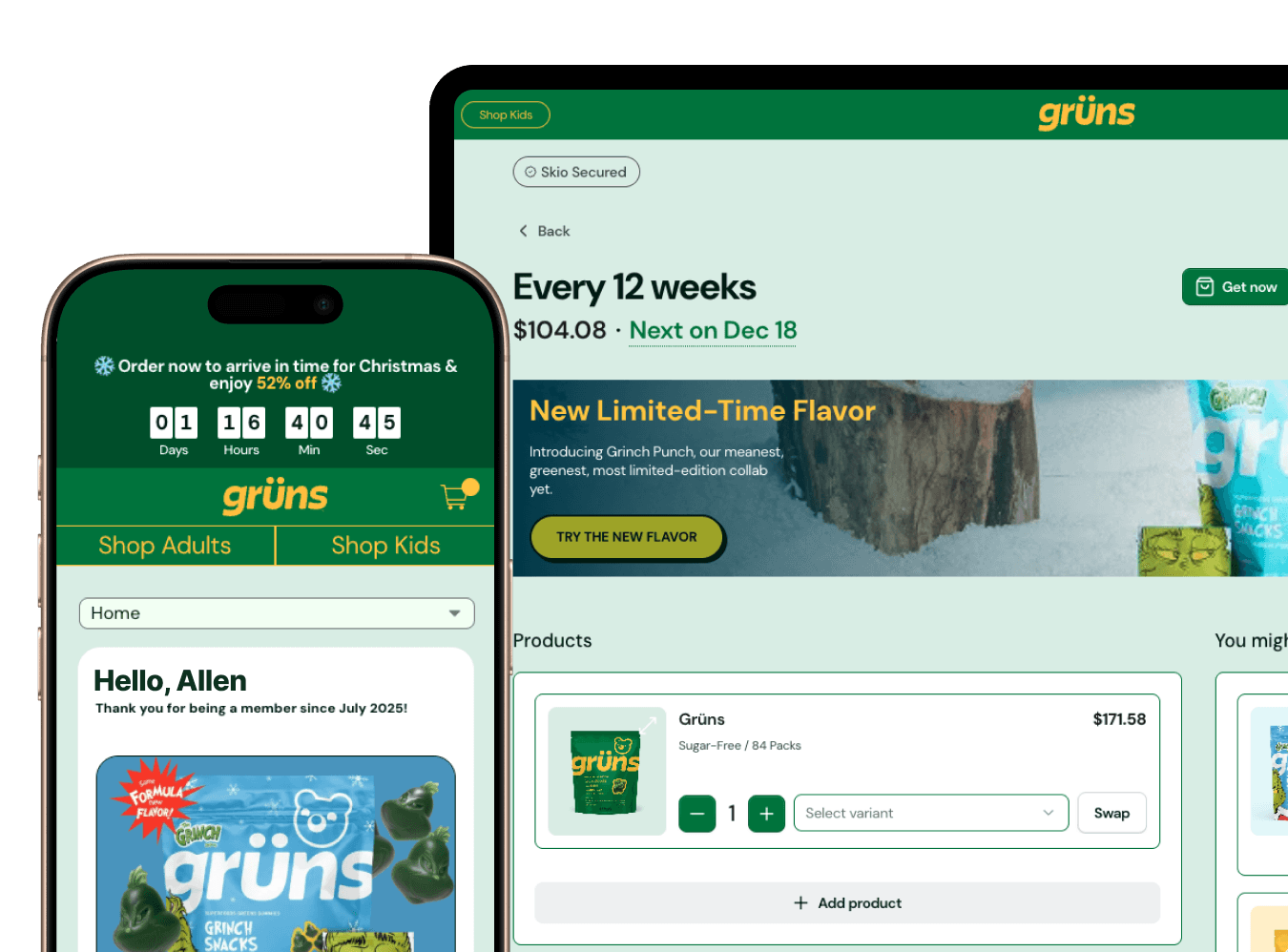
Credit balance lives in the customer portal. Customers see their credit balance in the same Skio Customer Portal where they manage their subscriptions — skip a shipment, change frequency, update payment method, check reward balance. One login, one place.
Checkout integration is native. Credits apply via Shopify's checkout extensibility. The Credit Redemption Block displays balance and applies it with one click. No code entry, no friction.
Recurring orders are fully supported. Credits apply on the initial subscription order and on every subsequent recurring charge. The system handles this automatically.
You control the rules. Expiration policies, stacking with discounts, minimum redemption thresholds — all configurable. Most brands start with no expiration and allow stacking, then adjust based on redemption data.
Full analytics visibility. Loyalty Analytics shows credits earned, credits redeemed, outstanding balances, and redemption rates by customer segment. You can see exactly how the program is performing.
Getting started with Skio Loyalty walks through the full setup. The core system is designed to be operational within a day.
Setting Up Credit Redemption in Skio (Step-by-Step)
For operators who want to get this running, here's the actual setup sequence:
Navigate to Loyalty > Credits in your Skio dashboard. This is where you configure earn rules and redemption settings.
Configure earn rules. Set subscription purchases to earn at a higher rate than one-time orders. A common setup: subscribers earn 5% back, one-time buyers earn 2%. This reinforces subscription value and incentivizes conversion.
Set credit value. The most intuitive framing is 1 credit = $0.01 (so 100 credits = $1). Customers understand this immediately.
Enable the Credit Redemption Block. Follow the setup guide to add the checkout block. This is what makes credits visible and redeemable at checkout without any customer friction.
Configure portal settings. Make credit balance prominent in the customer portal. Customers who see their balance log in more often and redeem more frequently.
Set up Klaviyo flows. Notify customers when they earn credits. A simple "You just earned $X in rewards" email drives redemption. Use Skio's Klaviyo integration to trigger these automatically.
Monitor in Loyalty Analytics. Track earn rates, redemption rates, and outstanding balances. The first 30 days of data will tell you whether your earn rates are set correctly.
The entire setup is self-serve. No development work required for the standard configuration.
What Happens When Credits Actually Work on Subscriptions
The operational impact of switching from gift cards to store credits shows up fast.
Support tickets about "rewards not working" drop to near-zero. Credits just work — there's nothing to explain. Your CX team stops fielding the same technical limitation question on repeat.
Redemption rates go up significantly. Subscribers redeem credits more often than one-time buyers redeem gift cards, partly because credits are frictionless and partly because subscribers have more opportunities to use them. Most brands see redemption increase 40-60% in the first 30 days after switching.
Average order value on subscription orders increases. When customers know they have credit to spend, they're more likely to add products to their next order to use it. Credits become a driver of AOV, not just a loyalty perk.
Subscriber retention improves. Credits give subscribers a concrete reason to stay — they have accumulated value they'd lose by canceling. Building out a credit redemption strategy as part of your broader loyalty approach amplifies this effect.
The loyalty program stops being a source of friction and starts doing what it was supposed to do: make subscribers feel valued and give them reasons to keep coming back. Understanding how credit stacking works with subscription discounts is the next step once your baseline credit program is running.
Store credits reduce support tickets, increase redemption rates, and turn loyalty into a real retention driver for subscription brands.
How to Migrate from Gift Card Rewards to Store Credits
If you're currently running gift card rewards and want to switch, the migration is simpler than it sounds.
Announce it as an upgrade. Tell customers you're improving how rewards work so they can use them on subscriptions. "Your rewards now work on every order, including your subscription" is a genuinely good message.
Convert existing balances at 1:1 value. Any outstanding gift card balances become store credits at equivalent value. Customers lose nothing.
Update program messaging. Change your website copy, loyalty program emails, and any onboarding flows that reference gift cards. Mostly copy updates.
Train your CX team. They should understand how credits display in the portal and how checkout redemption works. The main thing they need to know: the old ticket ("why can't I use my gift card on my subscription?") shouldn't exist anymore.
Set up Klaviyo notifications. The earn notification is the single highest-impact email you can send. Customers who know they have credits redeem them. Customers who forget they have credits don't.
Watch the Loyalty Customer Portal settings to confirm credit balance is displaying correctly for all customers.
Monitor redemption rates in the first month. The data will confirm the migration worked.
Why Standalone Loyalty Apps Keep Pushing Gift Cards
Smile, LoyaltyLion, and similar platforms were built for one-time purchase ecommerce. Gift cards made sense in that world — customers earn a reward, they use it on their next purchase, the loop closes cleanly.
Subscriptions broke the model. But these platforms have millions of existing customers and codebases built around gift card infrastructure. Rebuilding for subscription-aware credits would mean acknowledging that their core reward format doesn't work for a massive and growing segment of ecommerce.
So they don't acknowledge it. They keep offering gift cards, maybe add some language about "use on your next purchase," and let merchants discover the subscription problem on their own — usually via support tickets.
The integration complexity compounds the issue. When your loyalty program lives in a separate app with a separate login and a separate portal, the gap between "earned reward" and "used reward on subscription" is wide. Customers have to navigate multiple systems. Most don't.
Skio built loyalty directly into subscription infrastructure. Credit balance lives in the same portal as subscription management. Checkout redemption uses the same Shopify extensibility layer as subscription billing. No separate login, no gap to fall through.
The Operator's Checklist: Is Your Loyalty Program Subscription-Ready?
Run through these questions honestly:
Can customers redeem rewards on recurring subscription orders — not just the initial checkout?
Do customers see their reward balance in the same portal where they manage their subscriptions?
Do credits apply automatically at checkout without requiring customers to manually enter codes?
Can you weight earn rates to reward subscribers more than one-time buyers?
Can you track redemption rates separately for subscribers vs. one-time buyers?
Does your CX team regularly field tickets about rewards not working on subscriptions?
If you answered no to any of the first five questions, or yes to the last one, your loyalty program is creating friction for your subscription program instead of reinforcing it. That friction shows up as support tickets, frustrated VIPs, and churn you didn't have to accept.
Store credits, built natively into your subscription platform, solve the problem at the architecture level — which is the only level where it can actually be solved.
Frequently Asked Questions
Why can't I use Shopify gift cards on subscription orders?
Shopify's subscription API doesn't support gift cards as recurring payment methods. Gift cards are one-time codes, not vaulted payment instruments. Store credits work instead because they apply at checkout as order-level discounts, not as saved payment methods that need to be charged automatically.
What's the difference between gift cards and store credits for subscriptions?
Gift cards are payment methods that only work on one-time purchases. Store credits are checkout-level discounts that work on both one-time and recurring subscription orders. Credits integrate with subscription billing automatically — they reduce the order total before the vaulted payment method is charged.
Can I convert existing gift card balances to store credits?
Yes. Most brands migrate gift card balances to store credits at 1:1 value and announce it as an upgrade that makes rewards work on subscriptions. Customers see this as a benefit. Outstanding balances transfer cleanly, and customers don't lose anything in the transition.
Do store credits stack with subscription discounts?
Yes, if you configure it that way. Skio lets you control whether credits stack with other discounts or apply independently. Most brands allow stacking to maximize customer value on subscription orders. See the Loyalty FAQ for configuration details.
How do customers see their credit balance?
Credit balance displays in the Skio Customer Portal alongside subscription management. Customers see it every time they log in to manage their subscription, and it applies automatically at checkout via Shopify's checkout extensibility — no code entry required.
Can I set different earn rates for subscribers vs. one-time buyers?
Yes. Skio lets you weight subscription purchases higher than one-time orders. A common configuration: subscribers earn 5% back, one-time buyers earn 2%. This creates a concrete financial incentive to subscribe and stay subscribed.