
Table of Contents
Here's the thing nobody tells you when you go looking for "Shopify native subscriptions": it isn't a product. It's an API. Shopify gives you the plumbing — subscription contracts, billing cycles, selling plans — and then stops. There's no customer portal. No dunning. No cancel flow. No analytics. Every subscription app on the market, Skio included, is built on that same API. The difference between apps isn't whether they're "native." It's what they build on top.
Which means the real question isn't native versus third-party. It's whether your subscription program has outgrown what you can reasonably build and maintain yourself.
Upgrade from Shopify native subscriptions when you need dunning, cancel flows, or flexible product swaps — features the API doesn't support natively. This post gives you the decision framework: what the API actually hands you, what you're on the hook to build, and the five operational signals that tell you it's time.
What "Shopify native subscriptions" actually means
Shopify's native subscription infrastructure is an API that apps build on — not a standalone subscription solution.
The confusion is understandable, because the naming is genuinely bad. When Shopify announced native subscriptions, a lot of merchants heard "Shopify now does subscriptions." What actually shipped was the Subscription APIs: a way for apps to create subscription contracts, attach selling plans to products, and charge a vaulted payment method on a schedule.
What the API gives you:
Subscription contracts that live in Shopify, tied to the customer record
Selling plans — the frequency and discount structure attached to a product
Billing cycles and the machinery to charge on schedule
Vaulted payment credentials, so you're not handling raw card data
What it doesn't give you:
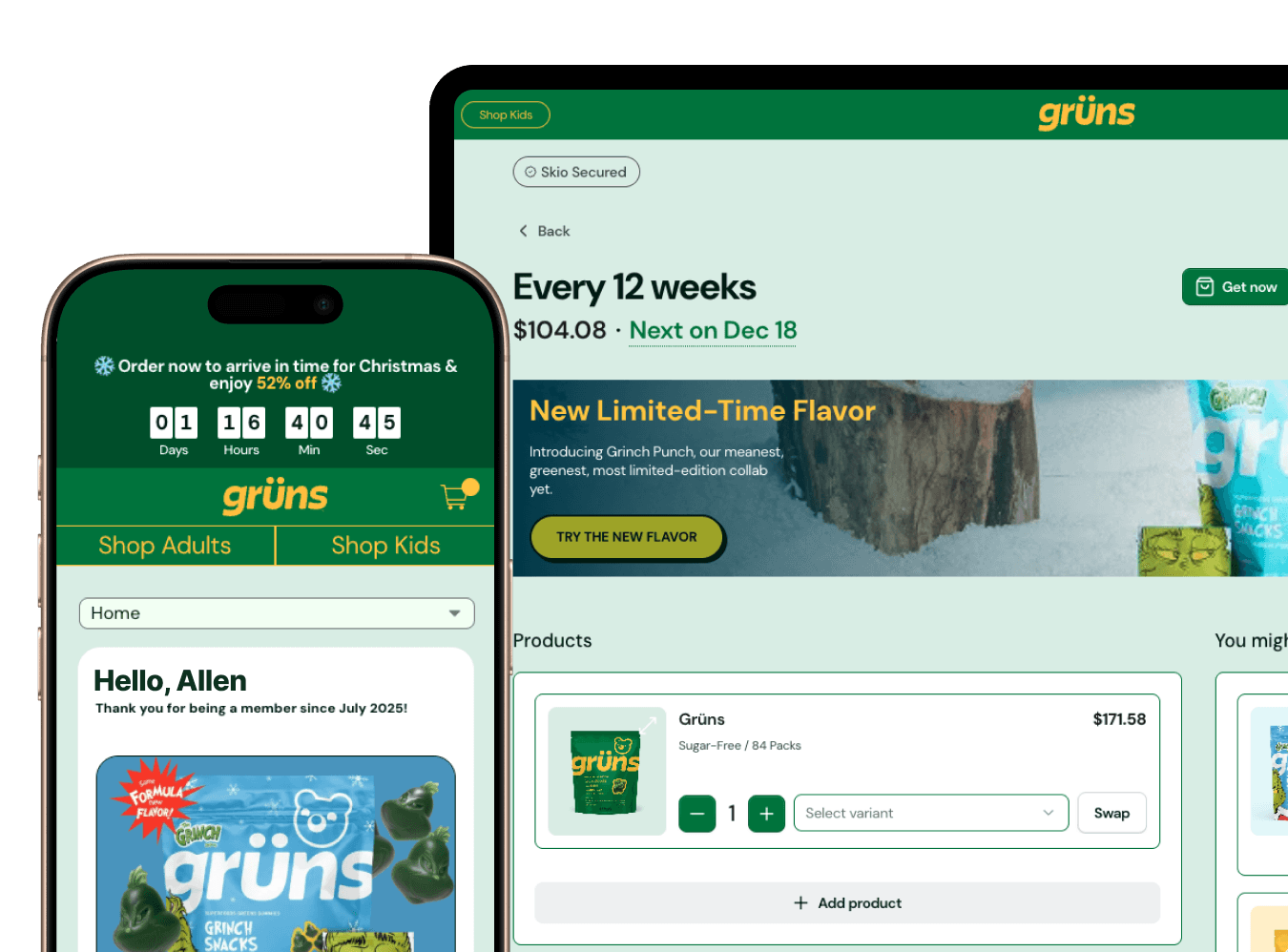
A customer portal where subscribers skip, swap, pause, or update a card
Dunning — any logic at all for retrying a failed payment
A cancel flow, or any mechanism to capture why someone left
Subscription analytics beyond raw order data
Notifications — upcoming charge reminders, payment failure emails, order confirmations
Upsells, add-ons, or anything that grows an existing subscription
That list is the entire product surface your subscribers actually touch. The API is the engine. Everything a customer sees, and everything your ops team uses, is something you either buy or build. Selling plans are where the API and the app layer meet, if you want to see the seam.
The hidden costs of "free" subscriptions
Building on the API directly is free the way a project car is free. The parts are cheap. The weekends are not.
The customer portal. Four to eight weeks of engineering for a first version, and that's for a portal that does the basics: view subscription, skip an order, update a card. Every feature after that — swaps, frequency changes, pause with a resume date — is more.
Dunning built out of Shopify Flow and cron jobs. You can approximate retry logic this way. What you can't approximate is retry timing informed by decline codes, which is the part that actually recovers money.
No cancel flow. Every cancellation is final and silent. You lose the subscriber and the reason, which means you can't fix whatever caused it.
Support tickets as the interface. Without self-service, every skip, swap, address change, and payment failure becomes an email a human answers.
Upsell revenue you never capture. There's no mechanism to let a subscriber add a product to their next order, so that revenue simply doesn't exist.
The maintenance is the part people underestimate. A portal isn't a project you finish. It's a surface you own forever, including the week Shopify changes something upstream and your card-update flow quietly breaks.
Five signs you've outgrown the API alone
These are diagnostic, not aspirational. You can check every one of them this afternoon.
Subscription tickets exceed 20% of your support volume. This is the clearest signal there is. When a fifth of your queue is people asking to skip, swap, or fix a card, you don't have a support problem — you have a missing product.
You're recovering failed payments by hand. If someone on your team pulls a list of declines and emails those customers, you're doing manually what dunning does automatically, and you're doing it slower.
Customers can't swap products or change frequency without help. Both are the most common reasons a subscriber contacts you, and both are the most common alternatives to canceling. If the only path runs through your inbox, some fraction just cancels instead.
You have no idea why people cancel. No cancel flow means no reason data. You're guessing at churn drivers, which means your retention roadmap is guesswork too.
You're writing custom code for standard subscription features. If a ticket in your backlog says "build pause," you're rebuilding something that already exists as a configuration toggle.
If subscription support tickets exceed 20% of your volume, you've outgrown managing subscriptions manually.
What a dedicated app actually adds
Capability | API alone | With a dedicated app |
|---|---|---|
Customer portal | Build it — 4-8 weeks for v1 | Configuration, live same day |
Dunning / payment recovery | Custom scripts or Flow workarounds | Built in, decline-code aware |
Cancel flows | Not possible without custom UI | Multi-step, with reason capture |
Product swaps | Custom build against the contract API | Self-service in the portal |
Subscription analytics | Raw order data, assembled by you | Cohorts, churn, retention curves |
Customer notifications | Build and maintain templates | Configurable, tied to events |
One-time upsells | Doesn't exist | Portal and email add-ons |
The column that matters is the middle one. Every row in it is engineering time you're spending on infrastructure rather than on your product.
The revenue you're leaving on the table
Two of these gaps cost real money, quietly.
Failed payments without dunning. A meaningful share of subscription charges fail every month for reasons that have nothing to do with intent — expired cards, reissued cards, a bank flagging a recurring charge. Without retry logic, every one of those is a canceled subscriber who never decided to cancel. That's passive churn, and it's the cheapest churn to fix because the customer still wants the product. Payment Recovery handles the retry timing rather than hammering the same token on a fixed schedule, which is what naive retry logic does and why it triggers fraud blocks.
Cancellations with no deflection. When cancel is a single button with nothing behind it, the people who click it all leave. A cancel flow puts alternatives in front of them first — skip this one, pause until you need it, swap the flavor you're tired of — and a real share of them take one. Just as valuable: the reason data. Even a brand with a hundred subscribers benefits from knowing whether people leave over price, cadence, or the product itself.
No mechanism for add-ons. One-time upsells let a subscriber add something to their next order without touching their recurring lineup. On the API alone, that revenue line is zero — not small, zero.
When to stay on the API (yes, sometimes)
Not everyone should upgrade, and pretending otherwise would be a sales pitch rather than advice.
Stay where you are if you're pre-launch or genuinely testing whether subscriptions fit your product. Stay if your use case is one product, one frequency, no customization, and a subscriber count you could still name individually. Stay if you have an engineering team that wants control, has the bandwidth, and is clear-eyed that the portal is now a product they own.
The one caveat: even early brands benefit from cancel reason data, because that's how you learn whether you have subscription-market fit before you scale spend against it.
What to look for in a subscription app
Native Shopify checkout. Not a redirect to a hosted page. Redirects cost conversion and break the trust the Shopify checkout has already earned.
Dunning with retry logic that reads decline codes. "Retry every 24 hours" is not a strategy.
Cancel flows with deflection offers and reason tracking. Both halves matter — one saves the subscriber, the other tells you why they nearly left.
A portal with passwordless login. Login friction is the single biggest reason self-service doesn't get used. A customer who can't get in doesn't retry; they email you or they cancel.
Analytics with cohorts, not counts. Total subscriber count tells you nothing about whether retention is improving.
One-time upsells and add-ons.
API access for the workflows that are genuinely specific to you.
Customer Portal v3 is worth looking at as a reference point for what the portal layer should cover: mobile-first, passwordless entry, and inline editing rather than a multi-step wizard for a frequency change.
The migration is smaller than you think
The fear here is bigger than the reality, and it's worth being specific about why.
Your subscription contracts live in Shopify, not in the app. Apps read and write against them. That means switching apps doesn't ask your customers to re-enter payment details, and it doesn't reset billing schedules — the tokens stay where they are.
What a migration actually involves:
Exporting current configuration — selling plans, discounts, subscriber state
Theme integration, usually one to two weeks on a custom theme
A testing period where you validate against live subscriptions before cutover
A customer communication plan, mostly explaining the new portal
Cutover timed to avoid a billing cycle
The migrations guide covers the sequence in detail. The short version: one to three weeks, and the technical work isn't yours.
Doing the cost math honestly
The comparison most brands run is app subscription cost versus zero, which is the wrong comparison. The real one:
Cost line | DIY on the API | Dedicated app |
|---|---|---|
Initial build | Portal, notifications, retry logic | Configuration time |
Ongoing maintenance | Yours, indefinitely | Included |
Support load | Every change is a ticket | Self-service absorbs most |
Failed payment recovery | Manual or nonexistent | Automated |
Add-on revenue | Zero | Incremental |
Most brands break even on subscription app costs at 100-200 subscribers when accounting for engineering time and support reduction. That range moves depending on how expensive your engineering hours are and how heavy your support load is, but the shape holds: the breakeven arrives earlier than people expect, because the support and recovery lines compound while the build cost is a one-time number you've already mentally written off.
FAQ
Can I use Shopify's native subscription features without an app?
Not practically. The Subscription API requires an app to access it. You'd be building that app yourself, which most brands find more expensive than using an existing one.
What's the difference between Shopify native subscriptions and an app like Skio?
Shopify provides the API. Apps build the portal, dunning, cancel flows, and analytics on top of it. Every subscription app uses the same underlying Shopify infrastructure — "native" describes the plumbing, not a product tier.
How long does migrating to a dedicated app take?
One to three weeks typically, covering theme integration, configuration, and testing. Custom themes take longer. Skio's migration team handles the technical work.
Will my customers need to re-enter payment information?
No. Subscription contracts and payment tokens stay in Shopify when you change apps. Customers keep their payment methods and billing schedules.
At what subscriber count should I upgrade?
Most brands hit the wall between 50 and 100 subscribers, when support volume stops being absorbable. But the trigger is operational load, not headcount — a hundred subscribers on a complex catalog is harder than five hundred on one SKU.
Do I lose subscription data when migrating?
No. Your subscription data lives in Shopify via the API. Apps read from it; they don't own it. That portability is the point.
The bottom line
"Native versus third-party" is a distinction without a difference — everyone's on the same API. The question worth asking is whether the layer above it is something you want to own. If subscription tickets are eating your support queue, if failed payments are being chased by hand, and if you can't say why people cancel, you've already answered it.