
Table of Contents
Your renewals are failing and it probably isn't your customers' fault. It's the layer nobody on your team thinks about until it breaks: where payment credentials live, and what your platform is allowed to do with them.
This sounds like an infrastructure problem, and technically it is. But it shows up in your business as three very unglamorous things — charges that decline for no good reason, support tickets from people trying to update a card, and a churn spike every time you switch platforms. Those are the symptoms worth caring about. The vault is just the cause.
Payment vaults store tokenized card credentials so subscriptions can renew automatically — and the architecture of that vault determines your authorization rate, your support volume, and whether you can ever leave your current platform.
The three problems that trace back to your vault
Start with symptoms, because that's what you actually observe.
Renewals fail on cards that are perfectly good. A customer's card expires, or gets reissued after a fraud alert, or the number changes when the bank sends a new one. The card in your vault is now stale. The customer has no idea — from their side nothing happened. They just stop getting shipments and eventually notice they're not being charged.
Updating a card is a support ticket. On a lot of platforms, changing a payment method means the customer has to log in, fail to log in, request a reset, then get bounced out to a checkout page to re-enter everything. Most people email you instead. Payment method updates are consistently one of the highest-volume ticket categories in subscription support, and almost all of it is avoidable.
Migrating platforms costs you subscribers. Not because the new platform is worse, but because tokens don't move. More on this below, because it's the one that surprises people most.
All three are downstream of vault design. Which is why "what vault do you use" is a better platform question than most of what's on a typical evaluation checklist.
What a payment vault actually does
Payment vaults convert card numbers into tokens that can be stored and reused without exposing sensitive data.
When a customer subscribes, you don't keep their card number. You can't — holding raw card data pulls your entire infrastructure into PCI scope, which is a compliance burden no DTC brand wants. Instead the vault stores the card and hands back a token: a reference that means nothing on its own but can be used to charge that card again.
The practical translation for a subscription business: the token is what makes recurring billing possible without the customer being present. Every renewal is your platform presenting that token and asking for money.
One distinction that matters and gets muddled constantly: a vault is not a gateway. The gateway processes the transaction. The vault stores the credential. A platform can have a great gateway relationship and a bad vault architecture, and the vault is the part that determines what you can do with the card over the following two years.
Why not all tokens are equal
This is the part with real operational consequences, so it's worth the two minutes.
There are broadly two kinds of stored credential:
Gateway tokens | Network tokens | |
|---|---|---|
Issued by | Your payment processor | The card network (Visa, Mastercard) |
When a card is reissued | Token goes stale, renewal fails | Issuer updates it automatically |
Authorization rates | Baseline | Typically higher |
Portability | Locked to that processor | Still not portable between vaults |
Network tokens are issued by card networks and automatically updated by issuers, while gateway tokens are processor-specific and require the customer to re-enter their card.
The row that matters for retention is the second one. With a network token, a customer who gets a replacement card keeps subscribing and never knows anything happened. With a gateway token, that same customer's next renewal declines, and now you're in a dunning sequence trying to win back someone who never intended to leave.
That's passive churn, and it's the most frustrating kind — the customer still wants the product, they just have a new piece of plastic.
Card account updater: the churn prevention nobody sees
Related, and worth knowing by name because it's a real question to ask a vendor.
Card account updater services let issuers push updated card details into a vault when something changes — expiry date rolls over, a card is reissued, a lost card is replaced. It happens silently at the vault layer. The subscriber takes no action and never receives an email.
Card account updater services automatically refresh stored credentials when cards expire or are reissued, preventing failed renewals before they happen.
The honest caveat: coverage isn't universal. Not every card type participates, and some debit products are excluded. It's a meaningful reduction in involuntary churn, not an elimination of it — which is exactly why you still want dunning behind it.
Retry logic is only as smart as the data it gets
Most people picture dunning as an email sequence. The email is the visible part; the retry is where the money is.
A naive retry strategy hits the same token on a fixed schedule — every 24 hours, three times, done. This is worse than useless in one specific way: repeated identical attempts against the same credential can look like card testing, and issuers start hard-declining you. You've now taken a soft decline and manufactured a hard one.
Intelligent retry reads the decline code and responds to what it says. "Insufficient funds" is a timing problem — retry after payday, not in an hour. "Do not honor" is often transient and worth a different cadence. "Stolen card" is not a timing problem and should never be retried at all.
Getting this right requires the vault to expose decline metadata to the retry layer. Some platforms can't, because their vault relationship doesn't surface it — so they retry blind on a fixed timer and call it dunning. Payment Recovery is the layer where this coordination happens, and it's the difference between recovering a failed charge and burning the credential trying.
Backup payment methods need vault support, not just app logic
A backup card sounds like an application feature. It isn't — it's a vault capability.
Storing a second credential per customer, and failing over to it cleanly when the primary declines, requires a vault that supports multiple tokens against one customer with a defined cascade. Platforms whose vault architecture assumes one credential per customer can't offer this at all, which is why the feature is conspicuously absent from a lot of tools.
Backup payment methods require vault architecture that supports multiple tokenized credentials per customer with intelligent failover logic.
When it works, the customer experience is nothing happening: the primary declines, the backup charges, the order ships. Enabling backup payment methods covers the setup.
The migration problem: tokens don't move
This is the one that catches teams off guard, and it deserves plain language.
Payment tokens cannot be migrated between vaults, requiring subscribers to re-enter payment information during platform switches.
A token is meaningless outside the vault that issued it. It's a reference to a record in someone else's system. So when a brand moves from one subscription platform to another and that move involves changing vaults, every subscriber has to re-enter their card. Not "should" — has to. And a real portion of them simply won't, because you've just asked a happy customer to go find their wallet to keep something they were getting automatically.
That's a churn event you scheduled for yourself, and it's why some brands stay on platforms they've outgrown.
The way out is architectural. When the vault is Shopify's rather than the app's, the credentials belong to the store, not the subscription app. Changing apps doesn't touch the vault, so nobody re-enters anything and billing schedules continue untouched. This is the same reason subscription contracts survive an app switch — the data was never the app's to hold.
If you're evaluating platforms, this is the single highest-leverage question on the list: when I leave you, what happens to my customers' cards? The answer tells you whether you're choosing a vendor or acquiring a hostage situation.
How vault design shows up in your portal
The least obvious consequence, and the one your support team feels daily.
Whether a customer can update a card without leaving the portal is a vault question. Some platforms have to bounce the customer out to a checkout page to capture a new credential, because that's the only surface authorized to touch card data in their setup. Every one of those redirects is a place customers drop off, and every drop-off is a subscription that fails at the next renewal.
Vault architecture determines whether customers can update payment methods in-portal or must re-checkout, directly impacting support volume.
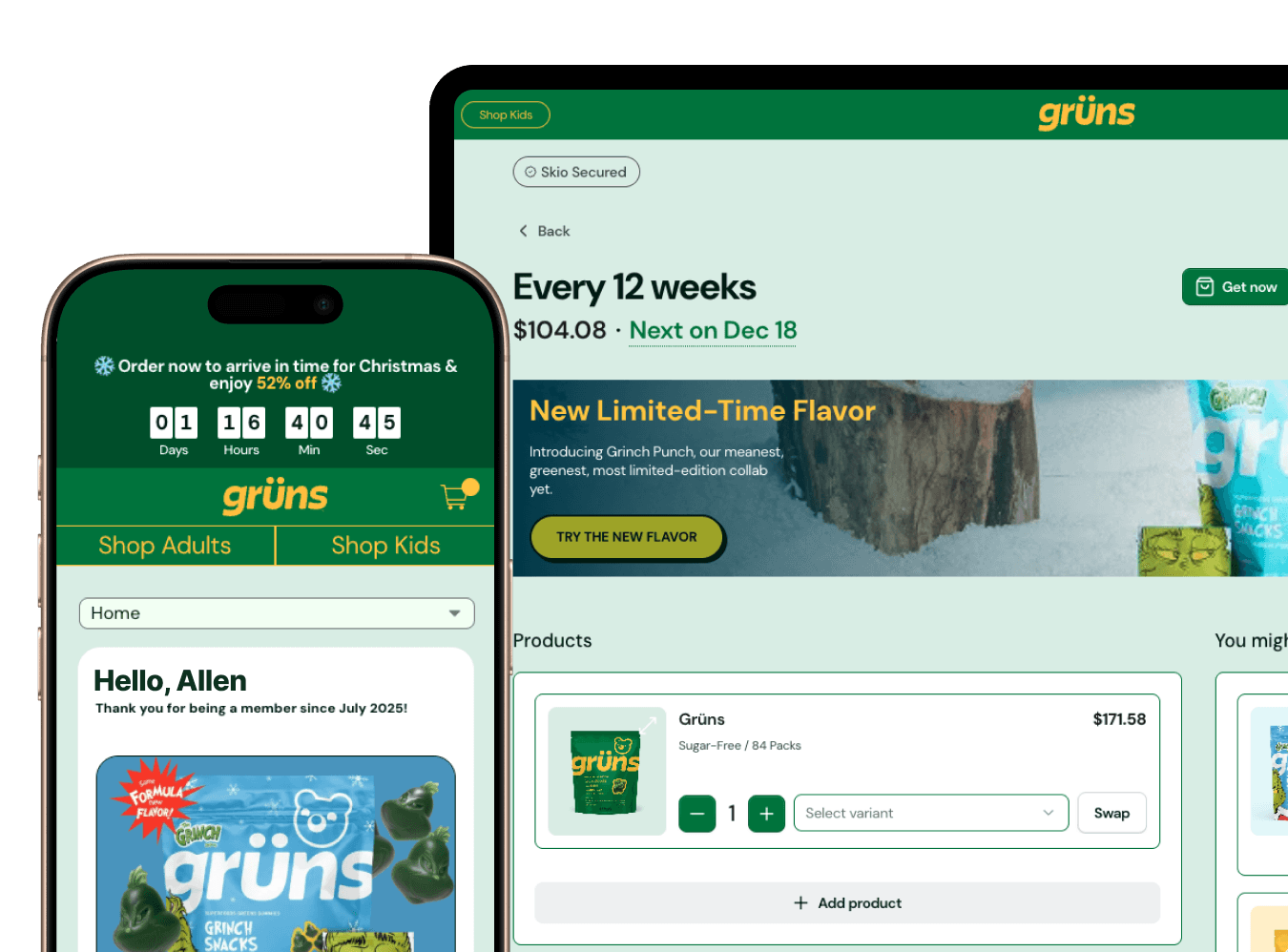
Using Shopify's native vault means the card form can be embedded directly in the portal — the customer updates in place and returns to what they were doing. Combined with passwordless login, the entire "my card expired" journey becomes: tap the link in the email, enter a code, update the card. No password reset, no redirect, no ticket. Updating cards in the Customer Portal walks through the flow.
That sequence is worth pausing on, because it's where the infrastructure argument becomes an operations argument. The reason payment-update tickets disappear isn't that customers suddenly became capable. It's that the vault permitted an in-place form and the login didn't require a password.
What to ask your subscription platform
Bring these to your next vendor call. The answers are diagnostic.
Do you support network tokenization, or only gateway tokens?
Are you integrated with card account updater services? Which card types are covered?
Can customers store a backup payment method? What's the failover logic?
If I migrate off your platform, what happens to my customers' stored cards?
Does your retry logic read decline codes, or does it run on a fixed schedule?
Can customers update a card inside the portal, or do they get redirected to checkout?
What PCI scope am I responsible for under your architecture?
A vendor who answers all seven crisply has thought about this. A vendor who redirects to "we're fully PCI compliant" has answered a different question — compliance is table stakes, and none of the above is about compliance.
FAQ
What is a payment vault in subscription commerce?
A secure system that tokenizes and stores customer payment credentials so subscriptions can renew without the merchant handling raw card data. It reduces PCI scope and, depending on token type, affects your authorization rates.
What's the difference between network tokens and gateway tokens?
Network tokens are issued by the card networks and get updated automatically by issuers when a card is reissued or expires. Gateway tokens are processor-specific and go stale when the underlying card changes, causing renewals to fail.
Can payment tokens be migrated between platforms?
Not between vaults — tokens are meaningless outside the system that issued them. If a platform change involves a vault change, subscribers must re-enter their cards. When the vault belongs to Shopify rather than the app, changing apps doesn't disturb the credentials.
What is card account updater and why does it matter?
A service that lets issuers push updated card details into a vault automatically. It prevents failed renewals from expired or reissued cards without the subscriber doing anything. Coverage varies by card type, so it reduces involuntary churn rather than eliminating it.
Why can't some platforms offer backup payment methods?
Because backup cards require a vault that stores multiple credentials per customer with failover logic. Platforms built around a single stored credential can't add this at the application layer.
How does a payment vault reduce PCI scope?
By keeping raw card data out of your infrastructure entirely — you hold tokens, not card numbers. This moves most merchants to the simplest compliance questionnaire rather than full validation.
The bottom line
Payment infrastructure is invisible right up until it's the reason your renewals fail, your support queue fills with card updates, and switching platforms costs you subscribers. You don't need to become a payments engineer. You do need to ask where the vault lives, whether tokens update themselves, and what happens to your customers' cards the day you decide to leave.