Table of Contents
Some of your subscribers cancel every month without ever deciding to. Their card expired, or got reissued, or the bank declined a recurring charge it didn't recognize. Nobody chose anything. The charge failed, a dunning sequence started, and a customer who still wanted your product quietly stopped being a customer.
Most retention work targets people who are leaving on purpose. This one targets the people who aren't.
Backup payment methods let subscribers add a second card that charges automatically if the primary fails, recovering failures instantly — before a dunning email ever fires.
The churn that happens while nobody's watching
Payment failures are a routine, structural feature of running a subscription business. A meaningful slice of charges fail every month, and the overwhelming majority have nothing to do with intent. Cards expire on a schedule nobody remembers. Banks reissue after a breach at some unrelated retailer. Fraud models flag a recurring charge as unusual precisely because it's automated.
The standard answer is dunning: retry the charge, email the customer, ask them to update their card. Dunning works. It's also entirely reactive — it starts after the failure, runs over days, and depends on a customer noticing an email and taking action.
Backup cards move the intervention earlier. The primary declines, the backup charges, the order ships. The customer finds out nothing, because nothing went wrong from where they're standing.
Backup payment methods recover failed charges instantly, before dunning emails fire, capturing revenue that would otherwise take days to recover.
What a backup payment method actually is
Mechanically it's simple, which is part of why it's overlooked.
The subscriber stores a second payment method in their portal. When a renewal charge on the primary card declines, the system immediately attempts the backup. If that succeeds, the order proceeds on schedule. No email, no dunning sequence, no gap in service.
A backup payment method is a secondary card on file that automatically processes if the primary payment fails, eliminating customer friction.
It covers the failure modes that make up most involuntary churn: expired cards, insufficient funds on one account but not another, and fraud blocks on a specific card. It does not fix a customer who has no working payment method at all — that's what dunning is for.
The distinction worth holding onto is proactive versus reactive. Dunning asks the customer to fix a problem. A backup card means the problem doesn't reach them.
Worth knowing: this isn't purely an app feature. Storing multiple credentials per customer and cascading between them requires vault-level support, which is why plenty of platforms don't offer it. Enabling backup payment methods covers the Skio setup.
Where backup cards sit in your retention stack
They don't replace anything. They're a layer in front.
Layer 1 — Backup card. Instant, silent, no customer action. Catches the failures that were never about intent.
Layer 2 — Dunning. Runs over several days for failures the backup couldn't catch. Retries with decline-code-aware timing and emails the customer.
Layer 3 — Cancel flow. For active cancellations, where the customer has genuinely decided.
You want all three because they address different failure types. A customer whose card expired needs Layer 1. A customer whose account is genuinely empty needs Layer 2. A customer who's bored of the product needs Layer 3, and no amount of payment infrastructure will help.
The compounding benefit: every failure caught at Layer 1 is a dunning email that never sends. That's less email fatigue across your base and a smaller, better-targeted dunning queue — the people receiving those emails are the ones who actually need them. Payment Recovery is where Layer 2 gets configured, and the two are designed to hand off cleanly.
The actual hard part: getting people to add one
Enabling backup cards takes about a minute. Getting adoption is the whole project, and it's where most rollouts stall.
Left alone, a small minority of subscribers will add a second card unprompted. That's not apathy — it's a rational response to being asked to do administrative work with no visible payoff. "Add a backup payment method" describes a chore. Nothing about it suggests a benefit.
Two things fix this: framing and timing.
Framing first. "Add a backup card" is about your billing system. "Never miss a delivery" is about their life. Same action, completely different conversion, because the second one names an outcome the customer actually wants.
Timing second. Ask during a moment when the subscriber is already in the portal with their guard down, not via a cold email asking them to go dig out a second card.
Five ways to actually drive adoption
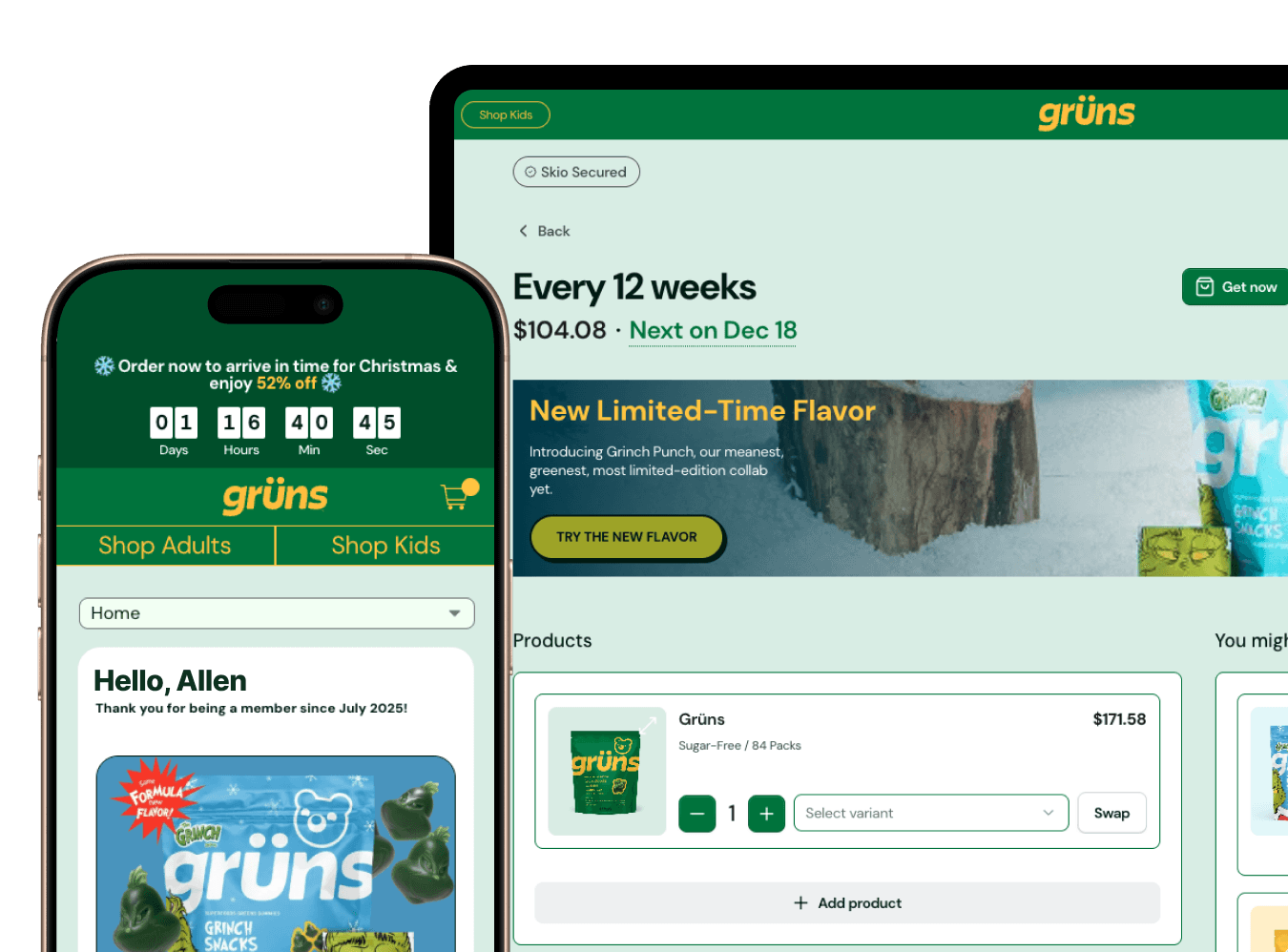
Prompt on first portal login. Engagement peaks the first time someone lands in their account. They're already oriented, already looking at their subscription. This is the highest-yield placement there is.
Attach an incentive. Loyalty points or a small credit for adding a backup card converts the chore into a transaction. Cheap, because you're paying once for a permanent reduction in involuntary churn.
Surface it during a swap or skip. The subscriber is already in the portal making a change. Adding one more field to an active session costs far less attention than starting a new one.
Ask right after a recovery. Someone who just had a payment fail and fixed it has felt the problem minutes ago. "Want to avoid this next time?" lands differently when the memory is fresh.
Target high-LTV subscribers directly. Frame it as priority processing for your best customers. These are the subscribers whose involuntary churn costs you most, so a focused campaign here pays back fastest.
Strategic prompts during high-engagement moments substantially increase backup card adoption compared to passive placement.
One thing that quietly gates all of this: login friction. A subscriber who has to reset a password to reach the portal will not be adding a backup card at the end of that journey. Passwordless login — a code by SMS or email rather than a password — removes the step where most of this intent dies. It's not a backup-card feature, but it's the reason the prompts get seen.
Setting it up
Go to Settings > Billing & Orders > Backup Payment Methods
Toggle on customer-added backup payment methods
Rewrite the portal prompt copy in your brand's voice — do not ship the default, it's the difference between a chore and a benefit
Test against a live subscription before rolling out broadly
Track adoption in the Dunning Dashboard
Step three is the one people skip and the one that determines whether this works.
Objections you'll hear internally
Objection | Response |
|---|---|
"Customers won't give us a second card" | Unprompted, most won't. Prompted at the right moment with outcome-led framing, adoption climbs substantially. The variable is your prompt, not customer willingness. |
"That's a security concern" | Backup cards are tokenized in the same PCI-compliant vault as the primary. You're not storing anything new; you're storing one more token. |
"Our dunning already works" | Good — keep it. Backup cards sit in front of dunning, they don't replace it. Every failure caught earlier is one your dunning sequence doesn't have to work on. |
"It adds checkout friction" | It isn't at checkout. It's a one-click add inside the portal, after the purchase decision is already made. |
What to measure
Adoption rate — share of active subscribers with a backup card on file. This is your leading indicator; everything else follows it.
Recovery split — failures caught by backup card versus by dunning. Shows you what Layer 1 is actually absorbing.
Time to recovery — average days from failure to successful charge. Should fall sharply as adoption rises.
Passive churn rate — before and after rollout. The number that justifies the project.
Dunning email volume — should decline. If it doesn't, adoption is too low to matter yet.
Watch adoption weekly for the first two months, then monthly. The failure mode is a rollout that gets enabled, never gets promoted, sits at low single-digit adoption, and gets written off as ineffective — when the feature was fine and the prompting never happened.
Why most brands sleep on this
Backup cards have a marketing problem: they produce invisible wins.
Dunning has a dashboard. You can watch recovery rates climb and feel good about it. Backup cards prevent the failure from entering the funnel at all, so the win shows up as an absence — charges that didn't fail, emails that didn't send, subscribers who didn't churn. Nobody gets to point at a number and say "look what I did."
So teams over-index on the visible problem and under-invest in the invisible fix. Which is genuinely good news if you're reading this, because the feature is sitting unused at most of your competitors while quietly being one of the cheapest churn reductions available.
Rolling this out over a month
Day 1. Enable backup payment methods in settings.
Day 2. Add the portal banner. Lead with the outcome: "Never miss a delivery."
Day 3. Email your top-LTV segment with an incentive attached.
Week 2. Add the prompt to your post-recovery flow, so anyone who just resolved a failure gets asked.
Week 4. Pull adoption and recovery numbers. Compare passive churn against your pre-launch baseline.
Month 2. A/B test prompt copy and placement. Adoption is the lever — keep pulling it.
FAQ
What is a backup payment method for subscriptions?
A secondary card stored on file that charges automatically if the primary declines, recovering the payment without any customer action.
How much do backup cards reduce churn?
They reduce involuntary churn specifically — the failures caused by expired or reissued cards rather than customer intent. Impact scales directly with adoption rate, which is why the prompting strategy matters more than the feature toggle.
How do I get subscribers to add one?
Prompt at high-engagement moments — first portal login, during a swap or skip, right after a recovered payment failure. Frame around the outcome ("never miss a delivery") rather than the mechanic, and consider a small loyalty incentive.
Do backup payment methods replace dunning?
No. Backup cards are the instant first layer; dunning recovers what slips past over the following days. Run both.
Are backup payment methods secure?
Yes. They're tokenized and stored in the same PCI-compliant vault as the primary card. No additional card data enters your systems.
Can every subscription platform offer this?
No. It requires vault architecture supporting multiple stored credentials per customer with failover logic. Platforms built around a single credential can't add it at the app layer.
The bottom line
Backup cards are the rare retention feature with no downside and no visible payoff — which is exactly why they're underused. Turn it on, then spend your energy on the part that actually determines the outcome: asking subscribers at the right moment, in language about their delivery rather than your billing system.