
Table of Contents
Build-a-box subscriptions promise customization and deliver support tickets. Customers love the idea of building their own bundle right up until they need to change it, and then they're emailing your team because the portal won't let them. Build-a-box subscriptions fail when customers can't modify bundles without contacting support, and the average brand sees a large share of tickets tied to product swaps.
The fix isn't less customization, it's self-service customization. A build-a-box that customers can edit themselves, that enforces its own rules, and that works on a phone turns the support nightmare into the retention feature it was supposed to be. Here's how to design it.
Why most build-a-box subscriptions create more problems than they solve
The promise is that customers love choice. The reality is that choice without self-service generates tickets. Customers can't edit bundles after checkout, so they email. Minimum thresholds are unclear, so they email. There's no way to swap an item without canceling, so some of them just cancel. Your support team drowns in manual swaps, and the customers who find it easier to quit than to change their box do exactly that. What a Champion needs is a build-a-box that reduces support load while lifting AOV, and that comes down to a handful of design decisions.
The two build-a-box models (and when to use each)
Static build-a-box uses pre-configured bundles. The customer selects from fixed combinations you've set up, each mapping to a Shopify product variant, so there's no custom logic and inventory, fulfillment, and analytics all work out of the box. It's the right call for a tighter catalog and a fast launch. Setup runs through the static build-a-box guide.
Dynamic build-a-box lets customers pick individual products and quantities, and modify the bundle before every shipment. It drives more engagement and AOV because people add more when they control the mix, but it needs real backend infrastructure: inventory checks per item, subscription line-level management, and a clean UX. Use it for a wide catalog where variety is the point. The dynamic build-a-box v3 guide covers the setup. The deciding question is how often your products change and whether customers want variety or consistency.
Minimum thresholds: enforce bundle rules without breaking UX
Minimum thresholds prevent unprofitable subscriptions by requiring a product count or price floor, enforced automatically at checkout and in the customer portal. The point is to stop a customer from subscribing to one $8 product with $12 shipping. Use a product-count minimum when your prices are uniform and a price minimum when they vary. The key is real-time validation: show customers exactly what they still need to add before they can check out, so the rule guides them rather than blocking them at the last step. Skio enforces the threshold at both checkout and in-portal, so a customer can't accidentally break their box after the fact.
The checkout experience: where build-a-box wins or dies
Customers have to see exactly what's in their box before they subscribe. No post-checkout surprises. Show the savings calculation in real time as they add products, and design for the phone first, because the majority of subscriptions start on mobile and your builder has to work on a narrow screen. Use the Checkout Link Builder to pre-populate boxes for email and SMS campaigns, and give customers a "review your box" step as one last confirmation before they commit.
In-portal bundle editing: the feature that eliminates most "change my order" tickets
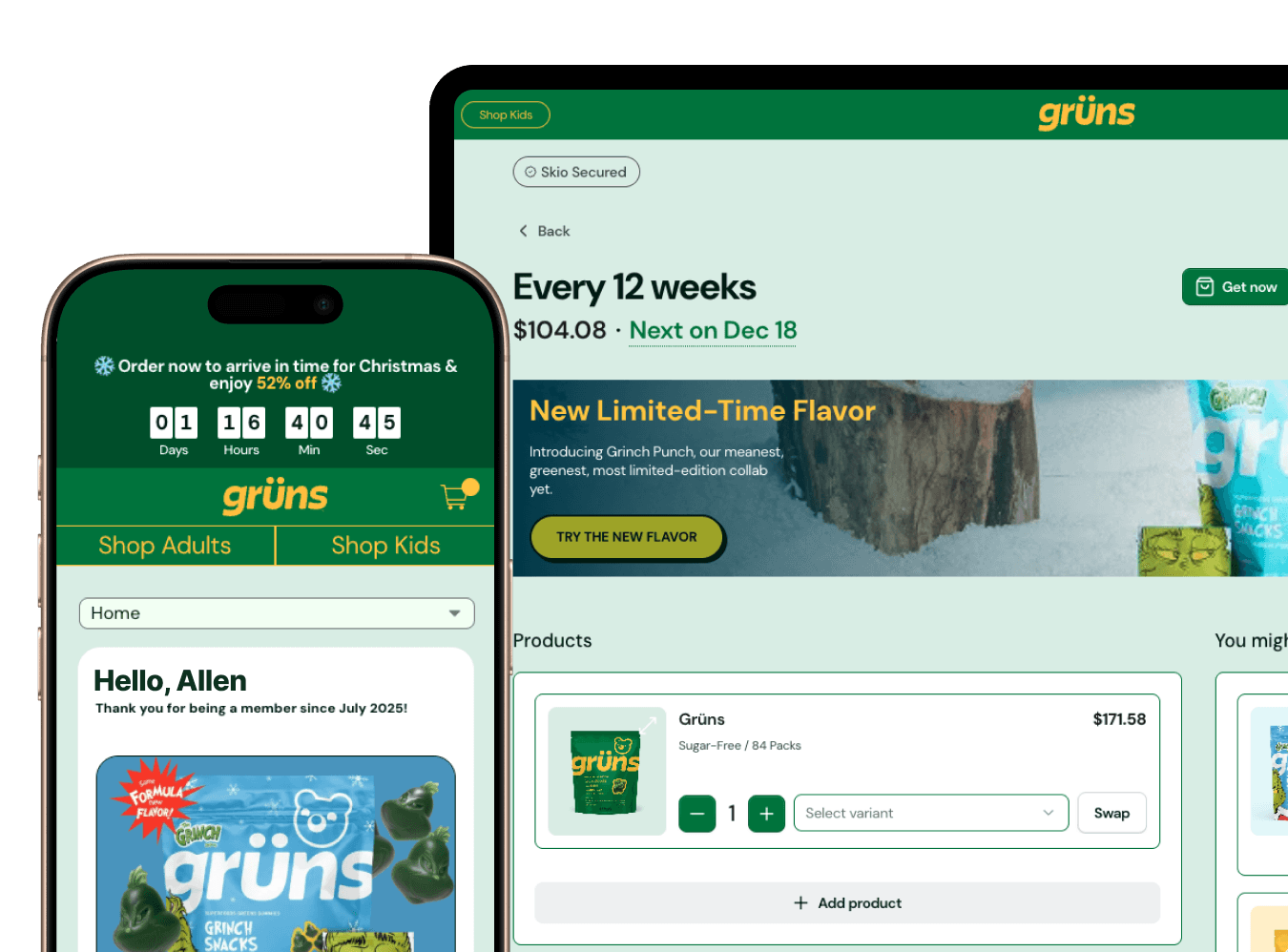
In-portal bundle editing lets subscribers swap products in two clicks, sharply reducing "change my order" support tickets. This is the single feature that justifies the whole build-a-box investment. The bottleneck is that customers who can't edit their box cancel instead of reaching out. Give them a two-click swap that doesn't require understanding subscription mechanics, show real-time inventory so they can't add an out-of-stock item, and auto-merge billing so adding products consolidates into one shipment. Enable all of this in the Customer Portal experience settings.
Preventing the multi-subscription trap: auto-merge and billing logic
Here's the trap: a customer builds box A, later adds product B, and now has two subscriptions charging on different days. Auto-merge billing combines them into one charge date automatically. The exception is customers who intentionally want different cadences, like coffee weekly and skincare monthly, so give them portal visibility into all active subscriptions rather than forcing a merge they don't want.
Sectioned build-a-box: enforcing "pick 2 proteins, 3 sides" rules
For meal kits, butcher boxes, and beauty boxes with category requirements, sectioned build-a-box enforces the rules. Customers must pick a set number of items from each category, and the validation logic won't let them proceed until every section is filled. The sectioned build-a-box guide covers setup for brands with complex bundle rules.
One-time upsells in build-a-box: boost AOV without complicating the bundle
While a customer is building their box, that's the moment to offer a one-time add-on: a recipe card, a bonus product, a limited-edition item. One-time upsells don't touch the recurring bundle, they ship once and fall off. Surface them in-portal during bundle editing and at checkout before final confirmation, where the customer is already in a buying mindset.
Mobile-first design: why most of your subscribers are on their phone
A large majority of subscription sign-ups happen on mobile, so build-a-box interfaces must prioritize thumb-friendly controls and real-time bundle visibility. The common mobile failures are tiny product images, no clear view of what's in the box, and threshold errors with no explanation. Design for thumbs: large tap targets, a sticky "review box" button, and the running total pinned to the top of the screen. Test on real devices, not just desktop dev tools, because touch behavior is genuinely different.
Variant swaps vs. product swaps: the technical difference that matters
A variant swap changes the flavor, scent, or size of the same base product, like chocolate to vanilla protein powder. A product swap removes one SKU entirely and adds a different one, like protein powder to pre-workout. The difference matters operationally, because a product swap requires re-validating the minimum threshold while a variant swap doesn't. Skio handles both, and the customer never needs to know which one they're doing.
Handling inventory and out-of-stock products
The nightmare scenario is a customer's box containing a product that's now out of stock, causing the renewal to fail. Real-time inventory checks stop customers from adding unavailable products in the first place. For products that go out of stock mid-subscription, inventory policy settings let you choose to continue the subscription without the item or pause until it's restocked. Best practice is to notify the customer in advance and let them swap.
How to launch without migrating your entire catalog
You don't need every product in the box. Start with your top 10 SKUs, create a separate build-a-box product in Shopify linked to eligible variants, and test with a small segment first by emailing your most engaged subscribers to gauge response. Then iterate based on what customers actually add to their boxes.
Measuring success: the metrics that matter
Track AOV to see whether build-a-box subscribers spend more than single-product subscribers. Watch "change my order" ticket volume, which should drop meaningfully after launch. Monitor retention, since the hypothesis is that customization drives engagement and stickiness. And use product-mix data to see which items customers actually add, then optimize your catalog around it. The Products Dashboard surfaces the product-level view.
FAQ
What's the difference between static and dynamic build-a-box subscriptions?
Static: customers select their bundle once at checkout and it repeats. Dynamic: customers can modify their bundle before every shipment. Use static for consistency like coffee samplers, dynamic for variety like meal kits.
How do minimum thresholds work in build-a-box subscriptions?
They require customers to select a minimum number of products or hit a minimum price before subscribing, which prevents unprofitable subscriptions. Skio enforces thresholds automatically at checkout and in-portal.
Can customers edit their build-a-box subscription after checkout?
Yes, if you enable in-portal bundle editing. Customers swap products in two clicks without contacting support, which is what drives the reduction in order-change tickets.
What happens if a product in a customer's box goes out of stock?
Skio's inventory policy settings let you continue the subscription without the out-of-stock item or pause until it's restocked. Best practice is to notify customers in advance and let them swap.
Should I use fixed pricing or variable pricing for my build-a-box?
Fixed pricing is simpler and creates predictable revenue. Variable pricing offers more flexibility and higher perceived value. Many brands use a hybrid: a minimum price threshold with a variable total.
How do I prevent customers from creating multiple subscriptions when adding products?
Enable auto-merge billing. When customers add products, Skio combines them into one subscription with one charge date, which prevents the multi-subscription trap.
The bottom line
Build-a-box doesn't have to bury your support team. Let subscribers edit their own bundles in two clicks, let the system enforce its own thresholds and inventory rules, and design the whole thing for a thumb. Do that and the feature that used to generate tickets starts preventing churn instead.