Table of Contents
Customer retention in subscriptions usually gets framed as a messaging problem: better emails, better offers, better timing. The data points somewhere less glamorous. A meaningful share of churn comes from customers who had a small, temporary problem and were only given one big, permanent tool to solve it: cancel.
Order-level management lets customers modify individual upcoming orders without changing their entire subscription, reducing friction that causes cancellations by 14%.
This post breaks down what order-level management actually is, why it moves retention metrics that messaging can't touch, and exactly what to enable to get the lift.
The 14% Churn Reduction: What the Data Shows
Merchants using order-level management see 14% lower churn because customers can solve immediate problems without canceling their entire subscription. Across Skio merchants, the reduction shows up in three places: skip rates replace a chunk of would-be cancellations, pause behavior becomes shorter and more recoverable, and cancel flow exits drop because fewer customers reach the cancel flow in the first place.
The shape of the difference matters as much as the size. Subscription-level churn is front-loaded: customers hit a temporary problem in months 2-4, find no surgical fix, and leave. Order-level churn curves are flatter through that window, because the temporary problems get absorbed by skips, swaps, and date changes instead of cancellations. Operational friction is a churn driver, which is exactly what MatchaBar found when they eliminated their support blockers.
What Order-Level Management Actually Means
Order-level management exposes each queued order as a modifiable object, not just a recurring schedule customers can only pause or cancel.
The distinction in one sentence each. Subscription-level management: "I need to pause my entire subscription." Order-level management: "I want to skip my March 15 order."
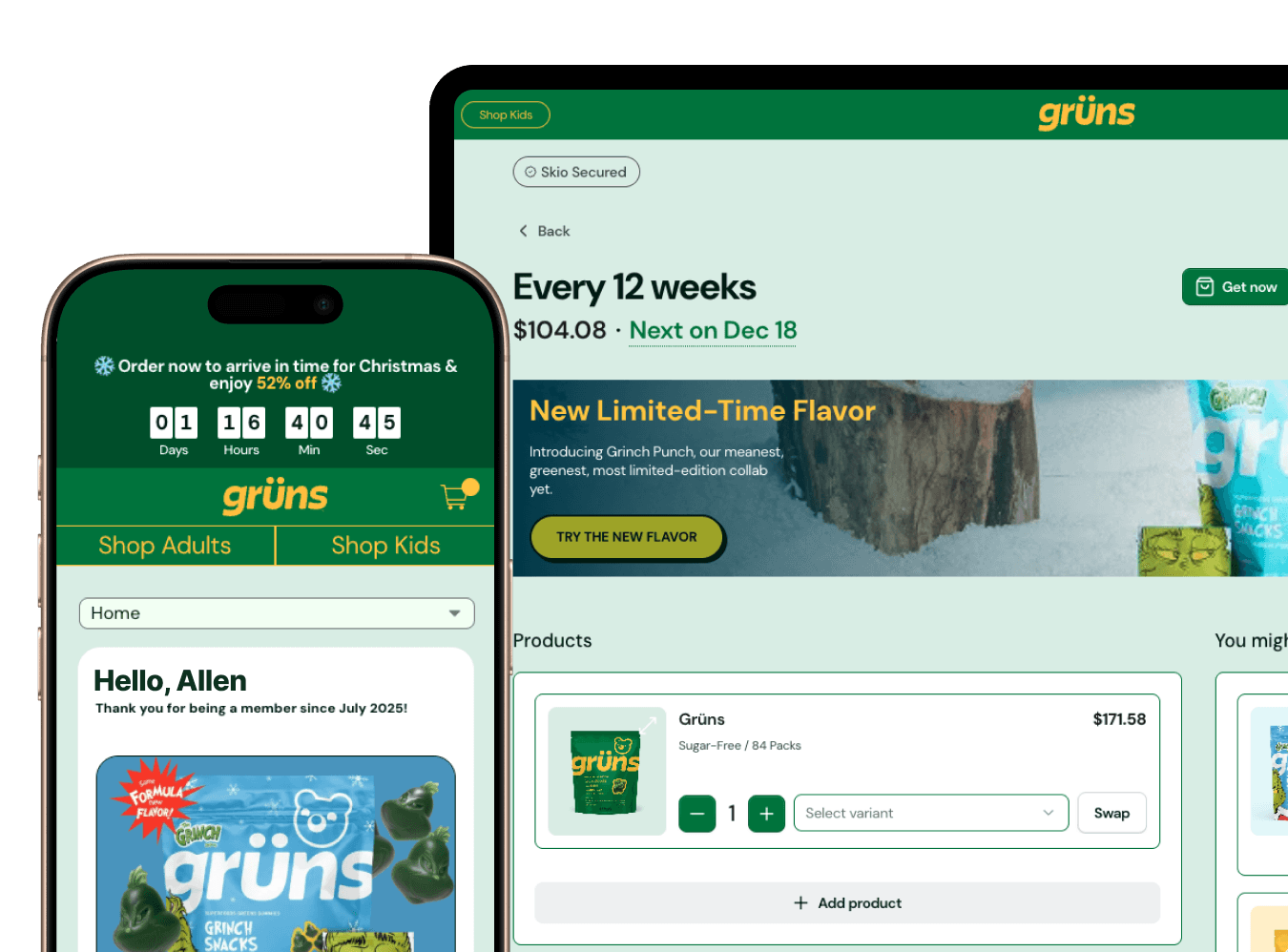
Technically, the difference is architectural. A platform built on recurring schedules stores one object (the subscription) and generates orders from it at billing time, so the only things a customer can edit are the schedule's properties: frequency, status, payment method. A platform built on queued orders treats every upcoming order as its own editable object before it processes. Skio's Customer Portal surfaces this as the Upcoming Orders view, where each queued order carries its own modify, skip, and delay actions.
For a Champion, this is the part that matters: it's a retention lever you can measure and optimize, not a UX nicety. Every order-level action a customer takes is a cancellation that something else absorbed.
The Four Retention Moments Order-Level Control Unlocks
Each retention moment represents a cancellation risk that order-level control eliminates by giving customers surgical precision instead of blunt subscription-wide changes.
Skip flexibility. "I have too much product" resolves with one tap on one order, no cancellation required.
Swap on demand. "I want to try a different flavor next order" doesn't require editing the whole subscription, so flavor fatigue stops being a churn reason.
Add-ons per order. "I need extra this month" becomes an AOV increase instead of an awkward separate purchase. Waterboy 4X'd add-on revenue on the strength of per-order one-time upsells.
Delivery date precision. "I'm traveling March 10-20" is a 5-day delay on one order, not a pause that the customer may never un-pause.
Why Subscription-Level Management Creates False Binary Choices
Subscription-level-only control turns temporary problems into permanent cancellations because customers can't solve small issues without drastic action.
Walk through the customer scenarios honestly. A vacation. A tight month. Flavor fatigue. A cabinet already full of product. Every one of these is temporary, and every one has a surgical fix. A platform that only offers pause or cancel hands the customer an amputation kit for a splinter.
The hidden cost is what happens after the pause. Pausing feels like the gentle option, but paused subscribers reactivate at low rates; the subscription falls out of sight, the habit breaks, and the pause quietly becomes a cancellation that never showed up in your cancel-reason data. Skips and delays keep the subscription alive and the next order visible, which is why they retain so much better than pauses for temporary problems.
The Support Ticket Reduction You Can Measure
Merchants see 60-80% fewer modification requests when customers can manage individual orders themselves, cutting support costs while improving retention.
Look at your ticket queue and count the requests that are really order modifications in disguise: "can you skip my next box," "can you push my delivery a week," "can I get the vanilla instead this month." Every one of those is a customer trying to do something your portal wouldn't let them do, routed through a human instead.
The cost math is straightforward. Take your modification-related ticket volume, multiply by your cost per ticket, and that's the operational saving on top of the churn reduction. For the rollout period, your support team can also perform order-level changes manually through the Subscription Management dashboard, which keeps CX unblocked while customers learn the new portal. SIMULATE cut support tickets dramatically on the same principle: self-service first, humans for exceptions.
How Skio's Customer Portal Exposes Order-Level Control
Skio's Customer Portal displays upcoming orders as individual modifiable objects, letting customers make surgical changes without altering their subscription schedule.
The Upcoming Orders view lists each queued order with modify, skip, and delay actions attached
Per-order actions include swapping products, adjusting quantities, adding one-time items, and changing the delivery date
Under the hood, Skio treats each order as an independent object before it processes, which is what makes per-order editing possible at all
Champions control which actions are exposed through Customer Portal experience settings, so the feature set matches your retention strategy
The Metrics Champions Should Track
Metric | What it measures | Where to find it |
|---|---|---|
Skip rate | Temporary problems solved without churn | Skio Analytics, Overview |
Per-order swap rate | Variety-seeking absorbed in-subscription | Skio Analytics, Products |
Add-on attachment per order | AOV lift from order-level upsells | Skio Analytics, Overview |
Modification-to-cancel ratio | Surgical fixes chosen over cancellation | Portal actions vs. cancel events |
Order completion rate | Health of queued orders, not just subscriptions |
Track skip rate, per-order swap rate, and modification-to-cancel ratio to measure how order-level control impacts your retention metrics. A rising modification-to-cancel ratio is the clearest signal the feature is working: customers reaching for the scalpel instead of the cancel button. If skip rate is high but reactivation after skips is low, investigate whether skips are masking a deeper product-fit issue.
Why Legacy Platforms Can't Do This
Recharge's subscription-schedule architecture can't expose individual orders for modification without breaking their billing system, leaving customers with blunt pause-or-cancel options.
This is a structural gap, not a missing feature on a roadmap. Platforms architected before Shopify supported native subscriptions store subscriptions as recurring schedules and generate orders at billing time. There's no queued-order object for a customer to edit, because the order doesn't exist until the charge fires. Retrofitting order-level control onto that architecture means rebuilding the billing core, which is why the gap has persisted for years despite obvious customer demand.
The practical consequence for merchants evaluating platforms: ask to see the customer's view of their next three orders. If the portal can only show a schedule and a next-charge date, every temporary customer problem on that platform resolves through pause, cancel, or a support ticket.
What This Means for Your Retention Stack
Order-level management becomes the foundation for retention optimization because it gives you granular control points to measure and improve.
It compounds with everything else in the stack. Cancel flows get better because the customers who reach them are genuine cancellation risks rather than people who needed a skip button. Dunning improves because engaged customers with modified-but-active orders update payment methods at higher rates. And your reporting gets sharper, because you can optimize order completion rate rather than only the blunt subscription retention rate. More granular metrics also mean better attribution when you're proving retention ROI to leadership.
Implementation: What Champions Need to Enable
In Customer Portal experience settings, toggle on skip, swap, delay, and per-order add-ons.
Configure Upcoming Orders visibility and the modification window (how close to the charge date customers can still edit).
Update your notification strategy: pre-renewal emails should remind customers they can skip or modify, which intercepts cancellations before they start.
Set a 30-day test plan. Baseline your churn rate, skip rate, and modification ticket volume now, then compare after enabling.
Enable skip, swap, and delay options in Customer Portal settings, then track modification rate and churn delta over 30 days to measure impact.
FAQ
What's the difference between order-level and subscription-level management?
Order-level management lets customers modify individual upcoming orders (skip, swap, delay). Subscription-level management only allows changes to the entire recurring schedule (pause, cancel, change frequency).
How does order-level control reduce churn?
It eliminates false binary choices. Customers can solve temporary problems like excess product, flavor fatigue, or travel without pausing or canceling their entire subscription.
Can customers still pause or cancel their subscription?
Yes. Order-level management adds granular control without removing subscription-level options. Customers get both surgical and blunt tools depending on the problem.
Does this increase support tickets from confused customers?
No. Merchants see 60-80% fewer modification tickets because customers self-serve changes they previously had to request through support.
How do I measure if order-level management is working?
Track skip rate, swap rate, add-on attachment per order, and modification-to-cancel ratio in Skio Analytics, and compare churn rates before and after enabling the features.
Can Recharge do order-level management?
No. Recharge's architecture treats subscriptions as recurring schedules rather than queued orders, so individual orders can't be exposed for modification without rebuilding their billing system.
The Bottom Line
Customer retention improves fastest when you stop forcing customers to choose between everything and nothing. Enable the order-level toggles, baseline your metrics, and watch the modification-to-cancel ratio for 30 days. The customers it saves were never unhappy with your product. They just needed to skip March.