
Table of Contents
Static bundles force subscribers into rigid product sets, creating churn when needs change. Product flexibility—swaps, volume discounts, and upsells—recovers 15-30% of at-risk subscribers. If your cancel flow is full of "I have too much of X" and "the mix doesn't work for me anymore," your bundle structure is doing the damage, not your product.
The Static Bundle Problem: Why Subscribers Cancel When They Can’t Swap
Static bundles make perfect acquisition tools. A curated starter kit feels premium, lowers decision fatigue, and converts well on a product page. The problem shows up three months later, when the subscriber has 47 travel-size shampoos they’ll never use, and the product they actually love is the one thing they can’t get more of.
The most common cancel reason for subscription box customers isn’t price. It’s product fit—specifically, the wrong product mix. “I have too much of X, not enough of Y.” What makes this genuinely painful: these subscribers don’t want to cancel. They want to change the contents. They’re telling you exactly what they need. You just don’t have the infrastructure to give it to them.
Static bundles create churn because subscribers can’t adjust products when needs change—they’re forced to cancel instead of swap.
Kitsch figured this out the hard way. Once they enabled product flexibility and let subscribers swap items, they cut churn in half. The subscribers were already there. They just needed a door that opened from the inside.
Most subscription platforms were architected around a simpler model: pick a product, pick a frequency, charge the card. Product flexibility was an afterthought, which means it usually requires manual intervention, custom development, or a support ticket that nobody wants to write. The result is a silent retention tax. You lose 15-30% of subscribers who would happily stay if they could just swap products. They can’t. So they cancel.
The Data: How Product Inflexibility Creates Churn
Static bundles are a churn driver, and the numbers make the case clearly.
15-30% of subscribers cite “too much product” or “wrong product mix” as their cancellation reason
Subscribers who swap products have 40% higher LTV than those locked into static bundles
The average subscriber makes 2-3 product changes over their subscription lifetime
Brands with product flexibility see 20-25% lower voluntary churn than those without it
Most churn happens between orders 3-6—exactly when product fatigue sets in and the initial excitement of the bundle wears off
That last point matters. Orders 1 and 2 are fine—the subscriber is still in the honeymoon phase. By order 3, they’ve accumulated product they don’t need. By order 6, they’ve made the mental calculation that canceling is easier than figuring out how to fix the mix. If you can’t give them a self-service path to fix it, you’re handing them a reason to leave.
Subscribers who can swap products have 40% higher LTV than those locked into static bundles. That’s not a marginal improvement—it’s a structurally different business outcome from the same customer base.
Why Most Subscription Platforms Can’t Solve This (And What That Costs You)
Most subscription platforms were built before Shopify had native subscription infrastructure. The architecture was designed around simple recurring billing—great for locking in revenue, terrible for giving subscribers any meaningful control over what arrives at their door.
Product swaps on these platforms typically require manual intervention. A subscriber emails support. Support logs into the backend. Support makes the change. The subscriber gets a confirmation email three days later, assuming the ticket didn’t get lost. That’s not a product swap feature—that’s a support nightmare with a feature label on it.
“Our support team was spending half their day on requests that should have been self-service. Subscribers would email us to skip, to swap, to pause—basic stuff that should happen in the portal.” — Director of Ecommerce at a $20M DTC brand
Support teams at subscription brands commonly spend 40% of their time processing requests that should be self-service. Every one of those tickets is friction. Friction creates frustration. Frustration creates churn. The worst part: the subscriber who emails support to swap a product is a highly engaged subscriber—they care enough to reach out instead of just canceling. When you make them wait three days for a basic change, you’re teaching them the relationship isn’t worth the effort.
Legacy platforms require manual support intervention for product swaps—self-service flexibility eliminates this friction entirely.
Everyday Dose put subscriptions on autopilot and cut support chaos by shifting to self-service. Their support team stopped being a product swap processing center and started doing actual customer success work.
The platforms that can’t automate this aren’t hiding the limitation—they’ve just normalized it. “That’s just how subscriptions work.” It’s not.
Solution 1: Let Subscribers Build (and Rebuild) Their Own Boxes
Dynamic Build-a-Box is the most direct answer to the static bundle problem. Instead of locking subscribers into a fixed SKU set, you define the rules—quantity limit, price threshold, eligible products—and subscribers pick what goes in the box. More importantly, they can change it.
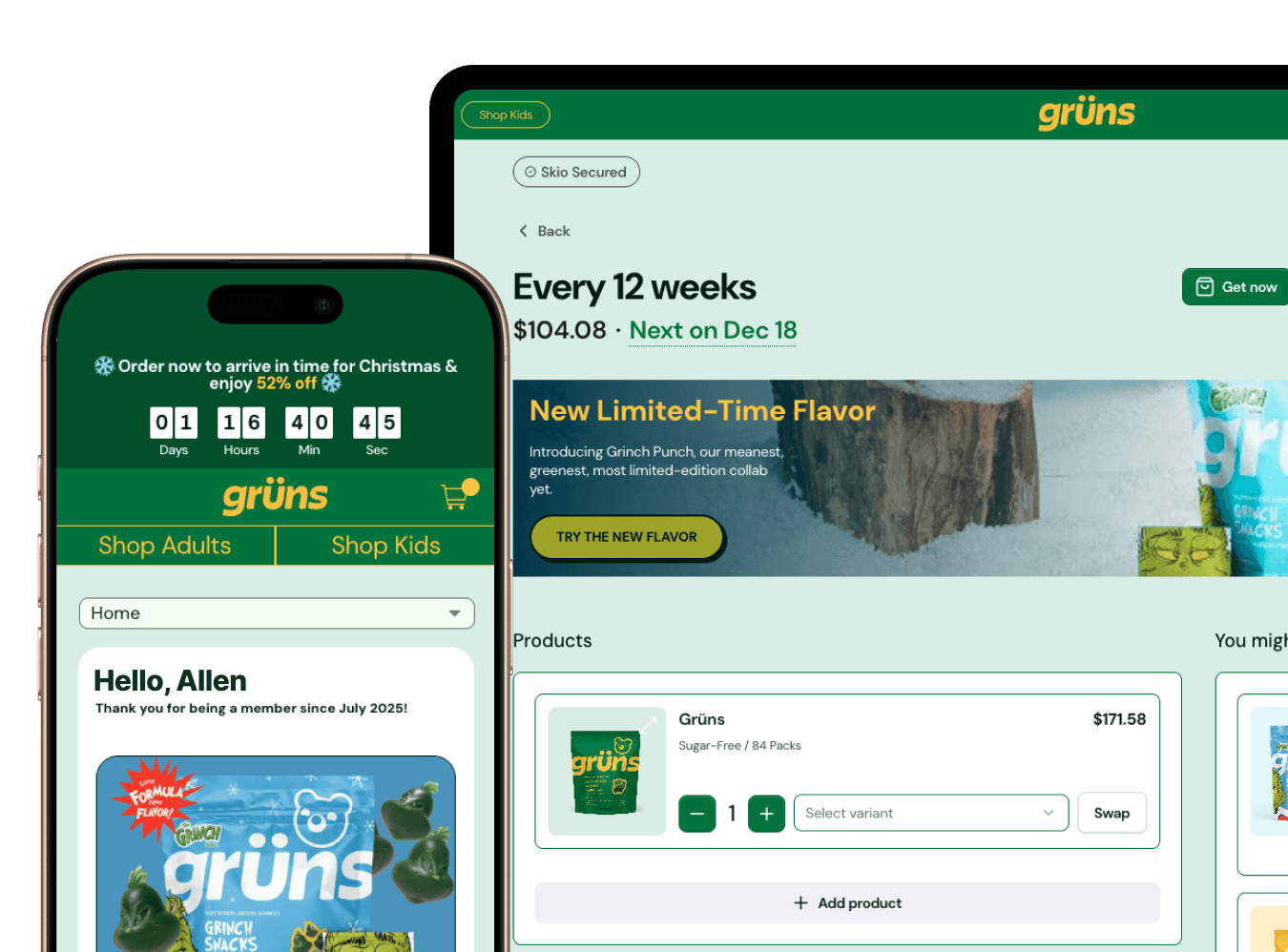
The mechanics are straightforward: a subscriber logs into the Customer Portal, sees their current box contents, and swaps items in or out before the next billing cycle. No email to support. No waiting. The subscription renews with the updated contents.
Dynamic Build-a-Box lets subscribers customize their product mix at any time—self-service swaps eliminate the most common cancel reason.
This works for almost any multi-SKU category:
Supplements: subscribers can shift toward products they’re actually running low on
Snacks and pantry: variety-seekers can rotate flavors without feeling stuck
Skincare: customers can adjust the routine as seasons change or skin concerns evolve
Pet food: households with multiple pets or changing dietary needs can rebalance the mix
The self-service part only works if subscribers can actually get into the portal. Customer Portal v3 uses passwordless login—subscribers get a magic link, click it, and they’re in. No forgotten password. No account recovery flow. No abandoned session because they gave up after two failed login attempts. Login friction is the silent killer of portal engagement, and removing it is what makes the flexibility features actually get used.
Solution 2: Use Volume Discounts to Incentivize Flexibility
Volume discounts solve a slightly different problem: subscribers who want to adjust quantities, not just swap products. The core mechanic is that the discount is tied to quantity or spend—not to specific SKUs.
“Buy any 3 products, get 10% off.” It doesn’t matter which 3. A subscriber can swap product A for product B and keep their discount. They can add product C and remove product D. The discount follows the behavior (buying in volume), not the specific items.
Volume discounts let subscribers change their product mix without losing their discount—flexibility without revenue loss.
Skio offers both quantity-based and price-based volume discounts. Quantity-based is cleaner for physical products with consistent unit economics—“buy 4, get 15% off.” Price-based works better for catalogs with wide price variation—“spend $80, get 12% off”—where you want to reward total order value without penalizing subscribers who choose higher-priced items.
The retention benefit is real: when a subscriber’s needs change, they can reorganize their order without losing the discount they signed up for. Removing that friction removes a cancellation reason. Volume discounts also naturally push toward larger orders, so you often see AOV increase at the same time churn decreases.
For skincare brands especially, how volume discounts replace rigid bundles is worth understanding in detail—the category has enough SKU variety and usage-rate variation that rigid bundles almost always create product accumulation problems.
Solution 3: Add One-Time Upsells Without Overwhelming the Catalog
Not every product flexibility problem is about the core subscription mix. Sometimes a subscriber just wants to try something new without committing to receiving it every month. One-time upsells solve exactly this.
One-time upsells let subscribers add a product to their next order only. It doesn’t change the recurring subscription. The order after that goes back to normal. The subscriber gets to experiment without anxiety about accumulation, and you get incremental AOV on that order.
One-time upsells let subscribers try new products without committing—AOV increases 12-18% without any churn risk.
The “I want to try X but don’t want it every month” friction is real and underappreciated. Subscribers who feel like adding a product means a permanent commitment will often skip the purchase entirely. One-time upsells remove that mental barrier. Because the core subscription doesn’t change, there’s no churn risk attached to the behavior.
Skio’s Smart Upsell takes this further with AI-driven recommendations based on what’s already in the cart. If a subscriber’s box is full of protein products, the recommendation engine surfaces protein-adjacent products—not random catalog items. An irrelevant upsell is noise; a relevant one is a service.
For more on scaling catalog without overwhelming subscribers, the tactical depth on sequencing and recommendation logic is worth the read.
How Skio Makes Product Flexibility Automatic (Not a Support Nightmare)
Product flexibility sounds operationally complex. In practice, Skio’s tooling makes most of it self-running once it’s configured.
Customer Portal v3 with passwordless login eliminates the single most common support ticket (“I can’t log in”). Subscribers who can get into the portal without friction actually use it—which means swaps, skips, and pauses happen without support involvement.
Self-service swaps, skips, and pauses are all configurable within the portal settings. You control what subscribers can change and how often. They handle the changes themselves.
Journeys automate product transitions based on order number, customer behavior, or lifecycle stage. The classic use case: after order 2, automatically swap a trial-size product for the full-size version. The subscriber doesn’t have to do anything—the swap happens based on a rule you set once.
Journeys + cancel flow integration means you can trigger a product swap offer at the moment a subscriber tries to cancel. Instead of offering a discount, you offer a product change. “It sounds like the current mix isn’t working—want to swap before you go?” That’s a retention save that doesn’t cost you margin.
Surprise & Delight rules let you automatically reward long-term subscribers with product additions—a new flavor, a sample, a bonus item on order 6. Product flexibility as a positive surprise, not just a churn prevention mechanism.
The Merchant Success team configures all of this based on your catalog and your customer behavior. Not documentation. Not a chatbot. Actual humans who have done this for hundreds of brands.
Skio’s Customer Portal and Journeys automate product flexibility—subscribers manage swaps themselves, no support tickets required.
Loyalty programs that reward product exploration compound these benefits—subscribers earn points for trying new products, which creates a positive feedback loop between flexibility and engagement.
Real Results: Brands That Fixed Bundle Rigidity
The numbers from brands that made this shift aren’t marginal improvements. They’re inflection points.
Kitsch cut churn in half and doubled subscribers. The product flexibility piece was central—subscribers who could swap products stayed. The ones who couldn’t, left. Enabling swaps didn’t require rebuilding the catalog; it required giving subscribers a door they could open themselves.
Cornbread Hemp grew subscriber count 88% and boosted their cancel flow save rate 150%. When subscribers tried to cancel, the system offered product alternatives instead of discounts. A significant portion of those saves came from product swaps, not price cuts—retention without margin erosion.
Gratsi (via Yocto) cut cancellations 48% and boosted reactivations 208%. Flexible bundles meant that when a subscriber’s needs changed, they adjusted their box instead of canceling. Reactivations spiked because former subscribers came back once they understood they could customize.
Heights slashed cancellations 152% and doubled subscribers. The brand sells cognitive supplements—products with different usage rates, different replenishment cycles, and customers with varying routines. Rigid bundles were creating accumulation problems. Flexible subscriptions let subscribers match their order to their actual consumption.
The common thread across all four: flexibility turns “I want to cancel” into “I’ll just swap products.” The subscriber intent was never really to leave—it was to fix the product mix. When you give them the tool to fix it themselves, most of them use it.
Brands enabling product flexibility see 15-30% lower churn and 40% higher LTV per subscriber. These aren’t theoretical projections. They’re what happened when real brands gave real subscribers real control.
When Static Bundles Still Make Sense (And When They Don’t)
Static bundles aren’t inherently bad. They’re just the wrong tool for long-term retention. Here’s how to think about when to use each approach:
Approach | Flexibility | Support Overhead | AOV Impact | Churn Risk | Best Use Case |
|---|---|---|---|---|---|
Static Bundle | None | High (swap requests) | Baseline | High (long-term) | Starter kits, gift subscriptions, first-order acquisition |
Dynamic Build-a-Box | Full | Very Low (self-service) | Moderate lift | Low | Variety-seeking subscribers, multi-SKU catalogs, retention |
Volume Discounts | High (any SKU combo) | Low | High lift | Low | Consumables with variable usage rates, AOV growth |
One-Time Upsells | Additive | Very Low | 12-18% per order | None | New product trials, seasonal items, catalog expansion |
Static bundles work for acquisition—starter kits, gifts, prepaid boxes. Dynamic flexibility is what keeps subscribers around long-term.
The right answer for most brands is a hybrid: static bundles for acquisition, dynamic flexibility for retention. The acquisition bundle is a great first impression. The flexible subscription is what keeps them around.
Starter kits that don’t create fulfillment chaos and first-order bundles that scale are worth reading if you’re optimizing the acquisition side—just make sure the retention infrastructure is in place before you scale acquisition.
How to Implement Product Flexibility Without Breaking Your Operations
The operational fear is understandable. “If I let subscribers swap products freely, won’t that create inventory chaos?” In practice, the answer is no—if you implement it methodically.
Start with one product category. Pick the category with the highest cancel rate or the most swap-related support tickets. Enable flexibility there first, measure the impact, then expand.
Enable Customer Portal swaps first, then layer in Journeys automation. Self-service swaps are the foundation. Once subscribers are using the portal, Journeys let you automate the transitions that happen predictably—trial-to-full-size, seasonal rotations, order milestone upgrades.
Set swap limits if needed. You can configure maximum swaps per billing cycle to prevent edge-case abuse. Most subscribers won’t approach the limit—the option to swap is usually enough to prevent cancellation, even if they rarely use it.
Use Bulk Operations to migrate existing subscribers from static to flexible plans. You don’t need to manually update thousands of subscriptions. Bulk Operations lets you swap products across subscriptions at scale—migrate a cohort, check the results, then migrate the rest.
Monitor your Cancel Flow analytics after launch. Track how many saves come from product swaps versus discounts. If swap saves are outperforming discount saves, you have clear evidence to expand flexibility across more of the catalog.
Start with one product category, enable Customer Portal swaps, then automate with Journeys—no full catalog overhaul required.
Store credit as a retention tool is also worth considering for situations where product swaps aren’t sufficient—credits give subscribers flexibility when the catalog doesn’t have a direct substitute.
Why Skio’s Merchant Success Team Matters Here
Product flexibility isn’t a feature you turn on and walk away from. It’s a strategy that requires configuration: which products are swappable, what limits make sense, how Journeys trigger, how Cancel Flows present swap offers, how the portal is branded and sequenced. Getting that configuration right is the difference between a flexibility program that reduces churn and one that creates operational confusion.
Skio’s Merchant Success team has configured this for over a thousand brands. They’ve seen what works for supplement brands with 50 SKUs and what works for snack brands with 200. They know the swap limits that prevent abuse without frustrating legitimate customers. They know the Journey triggers that catch subscribers at exactly the right moment in the lifecycle.
This isn’t a chatbot or a documentation library—it’s actual humans who understand subscription economics, your product catalog, and what your churn patterns are telling you. Enterprise customers get a dedicated Merchant Success Manager who knows your business well enough to recommend specific configurations, not generic best practices.
Skio’s Merchant Success team configures product flexibility strategies based on your catalog—not self-serve documentation.
Product flexibility pays for itself in 30-60 days. The configuration work is front-loaded. The churn savings compound. The Merchant Success team’s job is to get you to the compounding part as fast as possible.
Frequently Asked Questions
What’s the difference between static bundles and dynamic Build-a-Box?
Static bundles are fixed SKU sets—a “Starter Kit” with 3 specific products that every subscriber receives. Dynamic Build-a-Box lets subscribers pick any products up to a quantity or price limit, and they can swap items in or out at any time via the Customer Portal.
How do volume discounts reduce bundle churn?
Volume discounts reward quantity, not specific products. A subscriber who swaps product A for product B keeps their discount as long as they’re still buying the qualifying quantity. Flexibility without revenue loss.
Can subscribers swap products without contacting support?
Yes. Customer Portal v3 enables self-service swaps with passwordless login. Subscribers get a magic link, log in in seconds, and make changes themselves. No support ticket required.
What’s the ROI of adding product flexibility to subscriptions?
Brands with product flexibility see 15-30% lower churn and 40% higher LTV. Subscribers who swap products stay 2-3x longer than those who can’t. The configuration investment typically pays back within 30-60 days at meaningful subscriber volume.
How do I migrate existing subscribers from static bundles to flexible plans?
Use Skio’s Bulk Operations tool to swap products across subscriptions at scale. Skio’s Merchant Success team handles the migration strategy—you’re not doing this manually.
Do one-time upsells increase churn?
No. One-time upsells add products to the next order only—they don’t change the recurring subscription. AOV increases 12-18% without any change to the underlying subscription structure or churn risk.