
Table of Contents
Your loyalty program is probably costing you more than it's earning. Points programs are structurally broken for subscription businesses, and most brands don't realize it until they're staring at a 15% redemption rate and a growing pile of unredeemed liabilities.
Store credit redeems 40-60% faster than points because it’s cash customers already understand. No math, no tiers, no expired rewards sitting unused.
Here’s what that looks like in practice, why it happens, and how to switch without angering your existing subscribers.
The Loyalty Program Tax You’re Paying (And Don’t Realize It)
Points programs waste 80% of rewards on unredeemed balances while store credit converts at triple the rate.
Most subscription brands running points programs have the same experience: they set up the program, announce it to customers, see a small engagement bump in month one, then watch engagement flatline. Meanwhile, the points balance grows, redemption stays stuck in the 15-20% range, and the program quietly becomes a cost center.
The math is brutal. If you’re issuing $50,000 in rewards annually and only 18% get redeemed, you’ve spent real money on infrastructure, integration, and customer service overhead — while $41,000 in rewards sit unused. That’s a tax, not a loyalty program.
Store credit doesn’t have this problem. Brands switching from points to credits typically see redemption jump to 40-60% within the first 90 days. The mechanism isn’t complicated: credits show up as dollars, and people spend dollars.
“My predecessor really didn’t put an emphasis on retention. Retention is the foundation of any business like ours. We’re a subscription first.” — Director of Ecommerce at a $15M DTC brand
Heights understood this. After rethinking their retention stack — including how they rewarded subscribers — they slashed cancellations 152% and doubled their subscriber count. The right loyalty mechanic, built into the right experience, compounds.
Why Subscribers Ignore Points But Spend Credits Immediately
Credits feel like cash because they show up as dollars at checkout, not abstract points requiring mental math.
Think about how your customers experience your current points program. They earn 200 points on a $40 order. They open the loyalty portal — which is probably a separate app login from where they manage their subscription — and see “200 points.” Then they try to figure out what 200 points is worth. Is that $2? $5? Do they need 500 to redeem? Can they combine it with their subscription discount?
Most of them close the tab.
Store credit doesn’t create this cognitive friction. If a customer earns $2 back on a $40 subscription order, they see “$2.00 in store credit” in their account. They understand it immediately. When they check out next month, there’s a redemption block right in the Shopify checkout that shows their balance and applies it in one click.
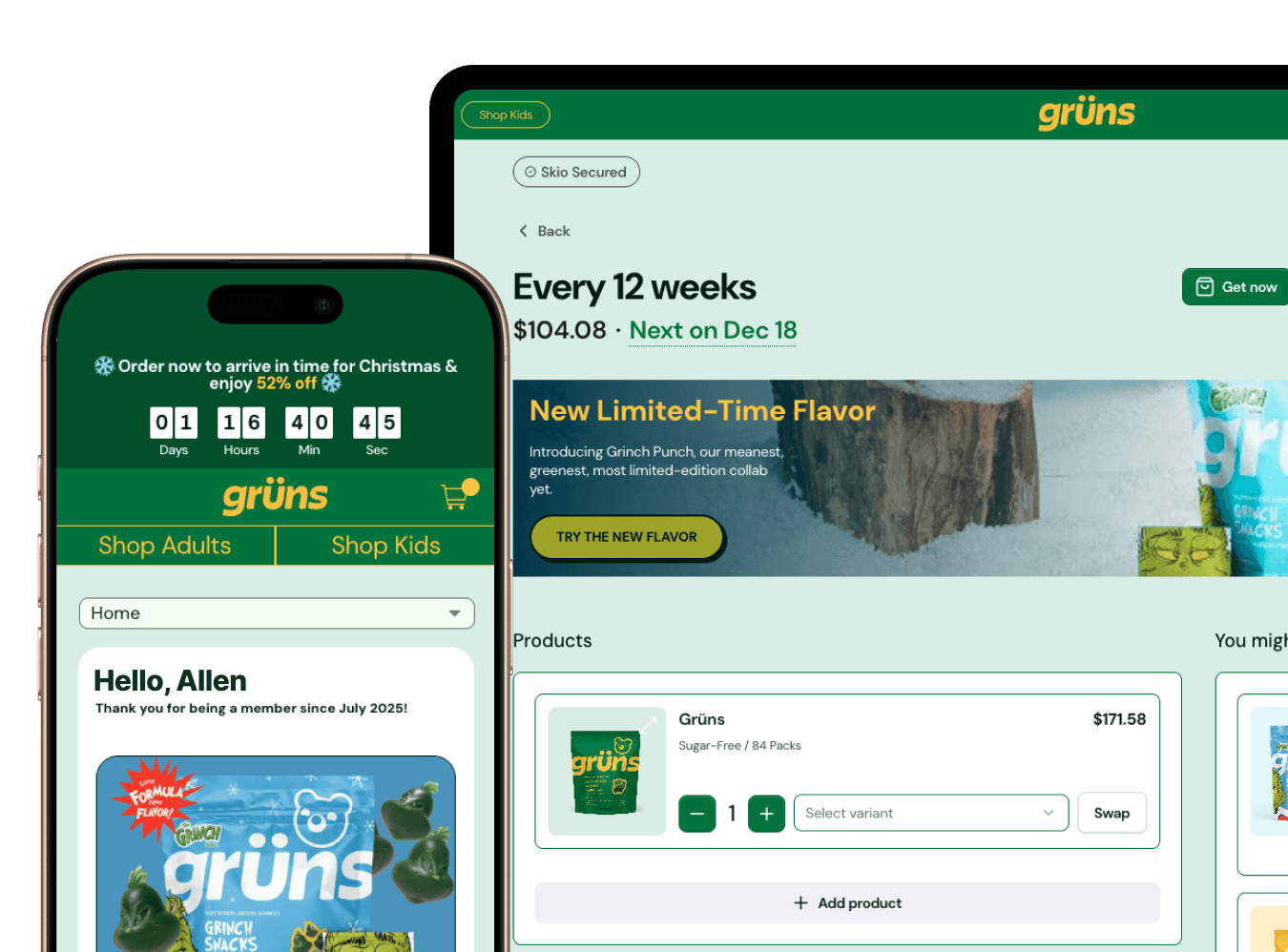
Skio Credits appear in the same Customer Portal where customers manage their subscriptions — same login, same page. No separate loyalty app. No second password. The credit balance is just there, visible, reminding them they have money to spend.
This matters more for subscription brands than for any other business model. Your customers log in to skip an order, update their address, or swap a flavor. When they see their credit balance in that moment, it’s a retention touchpoint. When they have to navigate to a separate loyalty portal to check their points, it’s friction — and most of them won’t bother.
The Hidden Costs of Running a Points Program
Every points program has costs that don’t show up on the vendor’s pricing page. Here’s where the money actually goes:
Support tickets from redemption confusion. “How many points do I have?” “Why did my points expire?” “How do I redeem at checkout?” These tickets are cheap individually and expensive in aggregate. Points programs generate this category of ticket permanently, because the confusion is structural, not fixable.
Separate login friction. When your loyalty app requires a different login than your subscription portal, customers get lost. Some email support. Some churn. A small percentage figure it out. None of this happens with native store credit.
Unredeemed points as a balance sheet liability. If you’re following proper accounting, unredeemed loyalty currency is a liability — money you owe customers. Points programs have redemption rates of 15-20%, meaning 80% of that liability sits on your books indefinitely.
Integration maintenance. Connecting a third-party loyalty app to your subscription platform creates data sync dependencies. When either tool updates, something breaks. Someone on your team spends time fixing it instead of doing retention work.
Tier complexity. Most points programs layer in Bronze/Silver/Gold tiers to add gamification. Each tier adds rules, edge cases, and customer service scenarios. For a subscription brand selling protein powder or supplements, this complexity returns nothing.
Skio Loyalty lives natively in the same portal as subscription management — one login, one vendor, zero integration tax.
“I killed it. We didn’t even replace it with anything. It was just embarrassing to me because it made us sound cheap.” — Retention Manager at a $10M DTC brand
That quote is from a merchant who shut down their points program before finding a better alternative. The brands who’ve been running points programs for 2+ years often feel the same way — the program looks good in a pitch deck and performs poorly in reality.
How Skio Credits Work (And Why Merchants Switch)
The mechanics of Skio Credits are straightforward, which is part of why they work.
Customers earn credits as a percentage of spend. The most common setup: 3-5% back on subscription orders, 1-2% on one-time purchases. A customer spending $50/month on a subscription earns $1.50-$2.50 in credit per order. Over a year, that’s $18-$30 in credit sitting in their account — real money that reinforces the value of staying subscribed.
Credits appear in the Customer Portal alongside subscription management. The customer logs in to change their next delivery date and sees their credit balance right there. No second tab. No separate login. Just a dollar amount that’s theirs to spend.
Redemption happens at Shopify checkout via a native app block. This is the part that exposes points programs in a direct comparison. Points programs almost universally redeem via discount codes — the customer copies a code, goes to checkout, pastes it in, hopes it works. Skio Credits apply in one click inside the checkout flow. No code. No friction. No abandoned carts from customers who couldn’t figure out redemption.
Merchants control earn rates, expiration policies (12 months is standard, or no expiration), and whether credits stack with existing subscription discounts. If you run a 15% subscriber discount, you decide whether credits layer on top or apply separately.
Brands switching from points to Skio Credits consistently report redemption rate jumps from the 15-20% range to 45-60% within 60-90 days. The improvement isn’t from marketing the program harder — it’s from removing the friction that was suppressing redemption in the first place.
The Psychology of Why Credits Outperform Points
People understand dollars. They don’t understand 500 points = $5.
That’s a design problem, not a knowledge problem. Points are deliberately abstracted to make rewards feel larger than they are (500 sounds better than $5) and to obscure the actual value. This works fine for airlines and hotels where the aspirational reward — a free flight, an upgrade — justifies the complexity. It doesn’t work for a subscription brand where the customer just wants to know if they’re getting a deal.
Credits create urgency that points don’t. When you have $12.40 sitting in your account, you think about spending it. When you have 1,240 points, you think about nothing in particular. The dollar framing makes the reward feel real and finite — something you could lose if you don’t use it.
This is exactly why showing credit balance in a Cancel Flow changes the retention math. When a subscriber clicks cancel and sees “You have $18.50 in store credit that you’ll lose if you cancel,” that’s a concrete cost of canceling. When they see “You have 1,850 points,” the emotional impact is near zero.
Skio’s Cancel Flow Loyalty Screen surfaces credit balance at the moment of highest churn risk — right when someone is about to leave. Merchants using Credits in their Cancel Flow see save rates increase by 10-15% compared to Cancel Flow alone. A brand running a 24% save rate without Credits can realistically expect to hit 34-38% by adding the loss aversion screen.
Kitsch used this exact approach — combining Loyalty with Cancel Flow as part of their retention stack — and cut churn in half while doubling subscribers. The loyalty program wasn’t a separate retention initiative. It was integrated into every moment where churn risk was highest.
When Points Actually Make Sense (Spoiler: Rarely for Subscriptions)
Points suit aspirational, infrequent purchases. Subscriptions need simple, immediate rewards like store credit.
Points work for airlines because the reward — a free flight — is emotionally significant enough to drive behavior despite the complexity. They work for hotel chains because high-value customers make infrequent purchases and the points accumulation over time feels like building toward something meaningful.
Subscription brands don’t fit this model. Your customer isn’t saving up for an aspirational reward — they’re buying the same product every 30 days. The loyalty program doesn’t need to be exciting. It needs to be frictionless. A 5% cashback that applies automatically at checkout does more for retention than a tiered points system with a free product at 10,000 points.
If your average subscriber LTV is under $200, points add complexity without measurable ROI. The overhead of running the program — support tickets, integration maintenance, tier management — likely exceeds the incremental retention value.
The one case where points might still make sense for a subscription brand: if you’re running a curated box or discovery-focused product where gamification genuinely drives engagement. Even then, the operational cost is real and the redemption problem doesn’t go away.
For consumable subscriptions — supplements, coffee, pet food, skincare, cleaning products — store credit wins every time.
How to Set Up Store Credit in Skio (If You’re Switching from Points)
Switching from points to credits takes under an hour in Skio: set earn rate, add checkout block, announce to customers.
Here’s the exact sequence:
Define your earn rate. Start with 3-5% back on subscription orders, 1-2% on one-time purchases. This creates a meaningful incentive for subscribers without cannibalizing margin on one-off buyers. Adjust after 90 days once you see redemption patterns.
Set your expiration policy. Twelve months is the most common setup. It creates mild urgency without feeling punitive. No-expiration is also valid if you want to eliminate expiration-related support tickets entirely.
Add the Credit redemption block to Shopify checkout. Follow the setup guide here. This is the step that moves the needle on redemption — without checkout-native redemption, you’re still relying on discount codes.
Enable Credits in Customer Portal settings. Your Customer Portal settings control where and how credit balance displays. Make sure it’s visible on the main portal page, not buried in a sub-menu.
Add the Loyalty Screen to your Cancel Flow. This is the step most brands skip. Go to your Cancel Flow settings and enable the loss aversion screen that shows credit balance. The incremental save rate improvement is immediate.
Announce the switch to subscribers via email. Use a Klaviyo flow to send a “Your rewards just got better” campaign to existing subscribers. Lead with the benefit — you now earn X% back on every order — not the mechanics.
Migration tip: If you’re converting from a points program, honor existing balances by converting at a fair rate (100 points = $1 credit is a common standard). Don’t orphan customers with unredeemed points — that’s the fastest way to generate angry emails.
For the full setup walkthrough, the Getting Started with Loyalty guide covers earn rate configuration, expiration policies, and portal settings in detail.
What to Do With Your Existing Points Program
Convert existing points to credits at a fair rate before you announce the switch. If a customer has 2,340 points and your conversion rate is 100 points = $1, they wake up to $23.40 in store credit. That’s a better experience than points, and most customers will see it as an upgrade.
Announce the change at least two weeks before you flip the switch. Send an email — and SMS if you have it — explaining what’s changing, what their new credit balance will be, and why it’s better for them. Frame it as “your rewards just got an upgrade,” not “we’re switching loyalty systems.” The distinction sounds small and matters a lot.
For high-value subscribers — customers in your top 10-15% by LTV — consider giving them the option to keep their existing points balance if they prefer. Most won’t take you up on it, but offering the choice reduces the risk of losing a $500/year subscriber over a loyalty program change.
Expect a support volume spike for 7-10 days after the switch. Most questions will be variations of “where did my points go?” — and if you’ve communicated the conversion clearly, these tickets resolve in one reply. By day 30, support volume from loyalty-related tickets is typically lower than it was before the switch, because credits are self-explanatory in a way that points programs never are.
“I know it’s not like a huge team with thousands of employees to do things. Very small team.” — Operations Lead at a $8M DTC brand
This is the reality for most subscription brands. You don’t have a dedicated loyalty manager. You have a retention person who also handles email, cancel flow optimization, and subscription reporting. The points-to-credits migration needs to be something a small team can execute and maintain without ongoing complexity. That’s what store credit is.
Loyalty Programs That Actually Move Retention Metrics
Credits alone don’t save subscriptions. They work best as part of a retention stack.
A credit balance is a reason to stay subscribed. But a customer who’s already decided to cancel needs more than one reason. The brands that see the biggest retention impact from loyalty programs combine Credits with Cancel Flow, payment recovery strategies, and Surprise & Delight to create multiple touchpoints where the value of staying is made explicit.
Here’s what the stack looks like in practice:
Retention Layer | What It Does | Impact |
|---|---|---|
Credits | Builds accumulated value that subscribers don’t want to forfeit | Passive retention, increases switching cost |
Cancel Flow + Loyalty Screen | Shows credit balance at moment of churn risk | 10-15% save rate lift vs. Cancel Flow alone |
Payment Recovery | Recovers failed payments before they become cancellations | Reduces passive churn |
Surprise & Delight | Adds unexpected rewards at loyalty milestones | Increases emotional attachment to brand |
The Cancel Flow Loyalty Screen is where Credits earn their keep on the retention side. A brand running a 24% save rate with a standard Cancel Flow can realistically target 34-38% by adding the loss aversion screen that surfaces credit balance. That’s what happens when you show someone real money they’re about to walk away from.
For how to build a Cancel Flow that actually saves subscribers, the best practices guide covers offer sequencing, reason collection, and how to structure multi-step flows for different cancellation reasons.
The brands that treat loyalty as a standalone acquisition tool — earn points, refer friends, get a discount — see modest results. The brands that treat loyalty as retention infrastructure — credits accumulating with every order, visible at every portal touchpoint, surfaced at every churn moment — see compounding returns. The program stops being a marketing line item and starts being a reason subscribers don’t leave.
FAQ
What’s the difference between store credit and points in a subscription loyalty program?
Store credit is dollar-value currency customers redeem at checkout. Points are abstract units that require conversion math before customers know what they’re worth. Credits redeem 3x faster because customers understand dollars instantly — no tier rules, no expiration confusion, no mental math.
How do I switch from a points program to store credit without angering customers?
Convert existing points to credits at a fair rate (100 points = $1 is standard), announce the change at least two weeks before you flip the switch, and give VIP customers the option to keep their points balance if they prefer. Expect a support spike for 7-10 days, then ticket volume drops permanently because credits are self-explanatory.
Do store credit rewards actually improve subscription retention?
Yes, when combined with Cancel Flows. Showing credit balance on the Loss Aversion screen increases save rates by 10-15% because customers don’t want to forfeit real money. Credits alone create passive retention by increasing the cost of canceling — combined with a Cancel Flow, they create active retention at the moment of highest churn risk.
Can customers use store credit on subscription renewals or just one-time orders?
In Skio, customers redeem credits at Shopify checkout for any order type — initial subscription, renewal, or one-time purchase. Merchants control whether credits stack with other discounts, so you can allow or prevent stacking with existing subscriber discounts based on your margin structure.
What’s a good earn rate for store credit in a subscription loyalty program?
3-5% for subscription orders, 1-2% for one-time purchases. The higher rate for subscribers creates a meaningful incentive for recurring revenue without cannibalizing margin on one-time buyers. Start conservative and increase if redemption rates suggest customers want more.
How does Skio Loyalty compare to third-party loyalty apps?
Skio Loyalty lives in the same portal as subscription management — one login, no separate app, no integration maintenance. Credits redeem via a native Shopify checkout block, not discount codes. When your loyalty program and subscription management share the same infrastructure, the customer experience is seamless and your operational overhead is a fraction of what it is with two separate tools.