
Table of Contents
Skio reduced customer support tickets by 80% by replacing traditional product roadmaps with direct operator feedback from intimate dinners and a private Slack community. No surveys. No webinars. No feature request boards where the loudest voice wins. Just eight subscription operators in a room being asked one question: what's actually breaking in your business right now?
Here’s what that model looks like in practice — and why it produces features that most platforms genuinely can’t replicate.
The Problem: Every Subscription Platform Has the Same Features Now
By 2023, you could build a feature checklist for subscription platforms and check nearly every box across all of them. Pause, skip, swap, cancel flows, dunning recovery, customer portals — all standard. The features that used to be differentiators became table stakes.
Feature parity means differentiation now comes from solving the right operator problems first, not building the most features.
That’s the shift most platforms missed. They kept adding features — more integrations, more dashboard widgets, more configuration options — on the assumption that more always wins. But operators running $10M+ subscription businesses weren’t asking for more features. They were drowning in support tickets, fighting passive churn, and watching subscribers cancel because logging into a portal was too much friction.
Legacy platforms built features based on internal roadmaps: product teams making educated guesses about what the market needed, filtered through sales feedback and NPS scores and the occasional customer advisory board where everyone says what the vendor wants to hear. Skio made a different bet — sit in rooms with operators who’ve actually scaled subscription programs, ask them what’s breaking, and build that.
The distinction sounds obvious in retrospect. Most good ideas do.
Why Webinars Are Where Insights Go to Die
Webinars optimize for scale, not truth. Here’s what actually happens on a vendor webinar:
100 people join a Zoom call. Maybe 60 have their cameras off.
The vendor presents a polished roadmap. Customers ask polished questions.
Nobody admits their churn is stuck at 12% or their support team is fielding 300 password reset tickets a week.
The vendor concludes the session feeling good about “engagement.” The operators leave having learned nothing they didn’t already know.
The vendor’s product team uses “great webinar attendance” as a proxy for customer satisfaction.
The format itself creates the problem. Public settings incentivize safe questions. No subscription operator is going to admit in front of 100 peers that their dunning recovery is terrible and they don’t know why. They’ll ask about integrations or API rate limits — things that sound sophisticated but don’t expose anything.
Skio killed webinars in early 2023 and replaced them with dinners for 8-12 subscription operators in LA, NYC, and Austin. The shift wasn’t logistical — it was philosophical. From “presenting our roadmap” to “what’s breaking in your business right now?”
What emerged from those first dinners: passwordless login (the number one support ticket driver that nobody was talking about publicly), payment recovery logic that adapts by decline code, and cancel flows that route by cancellation reason rather than presenting the same generic save offer to everyone.
None of that came from a webinar. None of it came from a feature request board. It came from operators who felt safe enough to say “this is actually embarrassing, but 70% of my support tickets are people who forgot their password.”
For a full breakdown of why we made this switch, see why we killed webinars for dinners.
The Dinner That Built Passwordless Login
Austin, June 2023. Eight DTC founders, all running subscription revenue between $5M and $30M annually. The dinner question: “What percentage of your support tickets are password resets?”
The answers ranged from 60% to 80%. Every single person in the room.
Think about what that means operationally. A brand doing $15M in subscription revenue has a CX team fielding tickets all day. If 70% of those tickets are “I forgot my password,” that’s not a customer experience problem — it’s an infrastructure problem. Subscribers couldn’t log in to manage their subscriptions, so they called support. Or they let their card decline. Or they emailed “cancel my subscription” instead of doing it themselves, because the login wall was easier to abandon than to climb.
The operators in that room weren’t complaining about missing features. They were describing a fundamental flaw in how subscription portals had been designed: for a desktop-first, password-remembering world that hadn’t existed for years.
No platform had solved this. The authentication layer had been built before mobile-first behavior became the norm, and nobody had gone back to fix it because doing so required rebuilding from scratch.
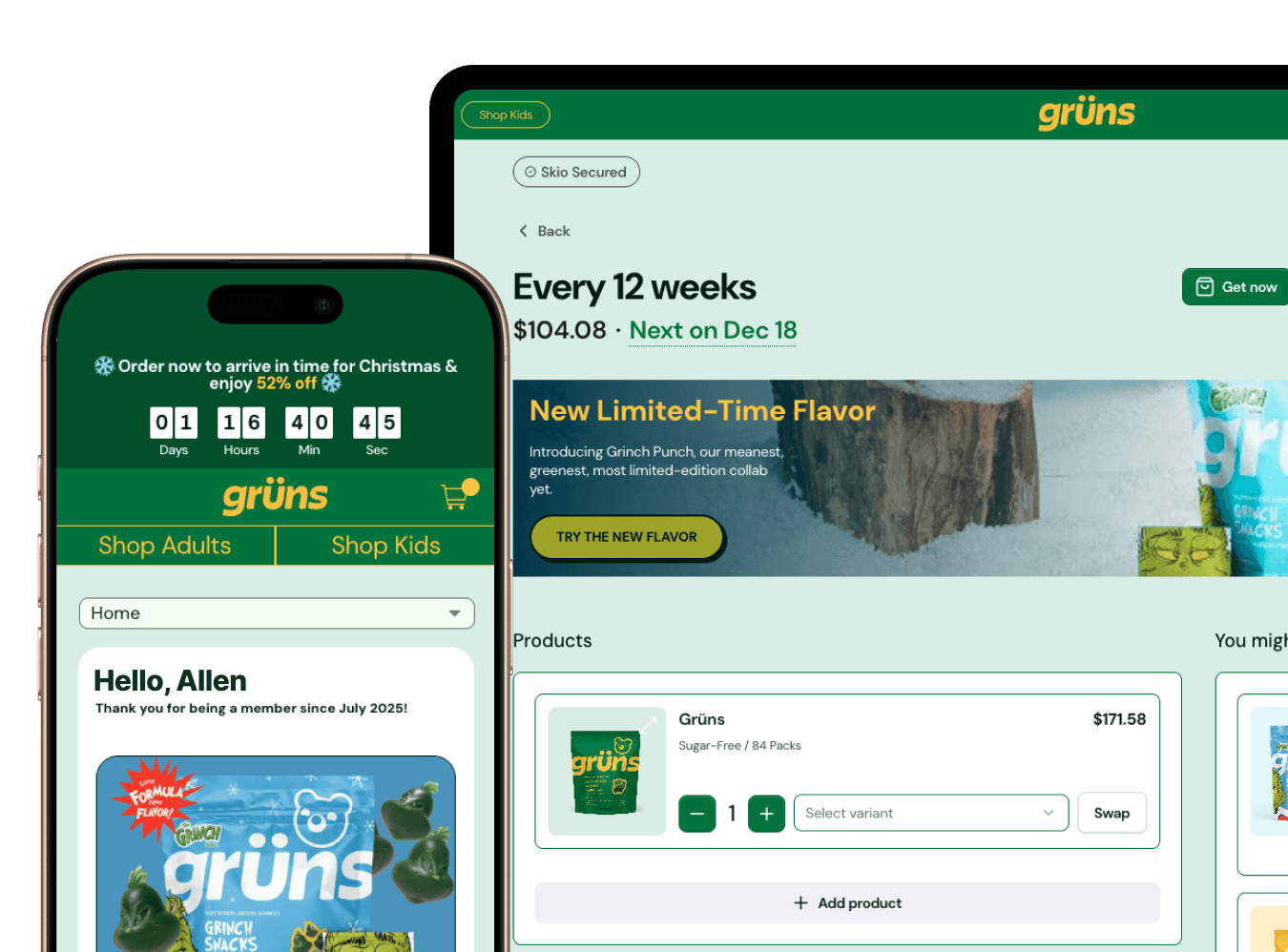
Skio shipped passwordless login six weeks after that dinner. Customers now get a 4-digit code via SMS or email — no account creation, no password to forget, no support ticket when they can’t remember what they used three months ago. You can see how to enable it in the customer login options guide.
Brands using it saw an 80%+ drop in login-related tickets immediately. Everyday Dose put their subscriptions on autopilot and cut support chaos substantially after implementation. The feature didn’t come from a product team brainstorm. It came from eight operators being honest in a private room.
“We didn’t realize how much of our support volume was just friction in the login experience until we saw it broken down. When you remove the password, you remove the problem.” — Director of Ecommerce at a $20M DTC brand
What “Community” Actually Means (and Doesn’t Mean)
Community has become one of those words that means nothing because it means everything. A Facebook group with 10,000 members is “community.” A Slack workspace with 5,000 lurkers is “community.” A LinkedIn group where vendors post promotional content is “community.”
None of that produces product insight.
Skio’s private operator Slack has 200 members. All of them are running active subscription programs. It’s invitation-only — you have to be generating real subscription revenue to get in. No agencies pitching their services, no consultants looking for clients, no early-stage brands trying to learn the basics.
The filter creates the value. What gets shared in that Slack:
Churn breakdowns by cohort, including the member’s actual numbers
Cancel flow save rates by reason category, with screenshots of the flows that work
Dunning recovery tactics that have been tested, not theorized
Klaviyo flow structures with real performance data attached
Actual P&L discussions about what subscription revenue looks like at different margins
The value exchange is direct: Skio gets unfiltered insight into what’s breaking at scale. Operators get peer benchmarks from people solving identical problems at similar revenue levels. There’s no vendor agenda in the conversations because the conversations are between operators, not between Skio and operators.
When 200 people who all know each other are talking, the signal-to-noise ratio is completely different from a public channel where anyone can post. Intimacy and exclusivity create the honesty that produces real insight.
The Features That Only Come From Operator Conversations
Every feature in this table has a direct line back to an operator conversation. None of them came from a roadmap.
Feature | Operator Problem It Solves | Why Competitors Missed It | Impact |
|---|---|---|---|
60-80% of support tickets were password resets | Legacy platforms built before mobile-first era, stuck with password architecture | 80% reduction in login-related tickets | |
Generic cancel flows treat all churn the same — price-sensitive cancelers need different treatment than “too much product” cancelers | Most tools optimize for scale; one-size-fits-all save offers are easier to build | Kitsch cut churn in half using reason-specific treatments | |
Insufficient funds needs different retry timing than an expired card or a fraud block | Legacy platforms use fixed retry schedules that don’t adapt to decline reason | Improved recovery rates without generating customer complaints about repeated charge attempts | |
Subscribers don’t want to log in just to skip one order — the friction causes cancellation instead | Most platforms assume portal login is acceptable friction for subscription management | Reduced cancellations from “I have too much product” by making skip a single email click | |
Backup Payment Methods | Primary card fails, subscription cancels even though customer has another card on file | Legacy platforms built before Shopify’s payment vault made this possible | Passive churn eliminated for customers who have a backup card but never needed to add it |
The pattern across all five: operators described a pain point in plain language, the Skio team identified the structural cause, and the feature shipped to solve the root problem rather than the symptom.
Cancel flow routing by reason is worth unpacking. Operators were saying “our cancel flow doesn’t work” — but the problem wasn’t the cancel flow itself. A subscriber canceling because the product is too expensive needs a discount offer. A subscriber canceling because they have six months of product in their pantry needs a pause or skip offer. Treating them identically means you’re solving the wrong problem for at least half your churning subscribers.
Why This Model Doesn’t Scale (And Why That’s the Point)
Dinners for 10 people don’t scale to 1,000 customers. A private Slack with 200 operators doesn’t scale to 10,000. The insight quality degrades as the group size increases — that’s not a hypothesis, it’s a property of how honesty works in group settings.
Legacy platforms optimize for scale: webinars, public roadmaps, feature request boards where the most-upvoted request wins regardless of whether it reflects operator sophistication or just operator volume. The loudest voice wins. The most common request wins. The median customer wins.
Skio optimizes for signal. Small groups of high-revenue operators who’ve already solved the problems newer brands are facing. The operators at a Skio dinner in Austin have already been through the churn crises, the payment failure spirals, the support ticket floods that happen at $2M ARR. Their problems are $20M ARR problems. Building for those problems means the platform is ready when brands hit that stage.
The trade-off is explicit: Skio can’t be everything to everyone. If you’re launching your first subscription program and doing $50K in monthly subscription revenue, Skio’s pricing and feature depth is probably more than you need right now. The platform is built for brands doing serious subscription revenue — $500K+ per month — who have hit the ceiling of what simpler tools can handle.
This is the same tension that applies to how top DTC brands approach generating 150+ ad concepts per month — at a certain scale, the playbook that got you here stops working, and you need infrastructure built for where you’re going. The operational bottlenecks that hit subscription brands at $10M look nothing like the problems at $1M, and platforms built to serve both simultaneously end up serving neither particularly well.
If you’re at $10M+ in subscription revenue and finding that your current platform can’t keep up with your operational sophistication, this model is built for you.
The Content Strategy That Emerges From Real Conversations
When you’re in rooms with operators, you hear the questions they’re actually searching at 11pm when something breaks. The content strategy writes itself.
“How do I reduce churn without discounting myself to death?” becomes a blog post, a case study (Kitsch cut churn in half), and a Cancel Flow template that operators can copy.
“Why is my dunning recovery rate stuck at 40%?” becomes improvements to the Dunning Dashboard and a help doc on payment recovery best practices.
“My team spends half their time on subscription management tickets that customers should be able to handle themselves” becomes the Customer Portal v3 development priority.
The content isn’t manufactured. It’s documented solutions to problems that operators already confirmed they have. There’s no guessing about whether anyone cares about the topic — you know they care because you watched eight people at a dinner table get animated about it.
Compare this to the typical SaaS content approach: generic “subscription best practices” posts that could apply to any platform in any industry, written by marketers who’ve never managed a subscription P&L. That content ranks for keywords. It doesn’t change how operators run their businesses.
Skio’s content is written by people who’ve been in those dinner conversations, or with operators who’ve scaled subscription revenue past eight figures. When someone reads a Skio case study about how LIVFRESH grew from 8,500 to 55,000 subscribers in 8 months, they’re reading a documented solution to a problem they recognize — not a testimonial engineered to sound impressive.
This mirrors what the best DTC brands do when they’re generating creative at scale — the ideas that convert come from real customer conversations, not from a content calendar.
How to Build This Model in Your Business
This isn’t specific to subscription platforms. The mechanism works for any B2B product where customer sophistication varies widely and the top 10% of your customer base faces qualitatively different problems than the median.
Step 1: Identify your top 20 customers by sophistication, not just spend. Look for the ones solving hard problems at scale. They’re often the same as your biggest spenders, but not always.
Step 2: Stop presenting to them. Start asking what’s breaking. The single most useful question: “What’s the biggest operational pain you’re dealing with this month?” Not “what features do you want?” — that produces feature requests. “What’s breaking?” produces problems to solve.
Step 3: Create a private space where these customers talk to each other. Slack, Circle, a group text — the platform matters less than the exclusivity. The conversations between customers are more valuable than the conversations between customers and you.
Step 4: Build from patterns, not one-off requests. One operator mentioning a problem is a data point. Five operators mentioning the same problem in different words is a product requirement. Wait for the pattern.
Step 5: Ship fast. The operator who told you about the problem should see the solution in weeks, not quarters. Speed is how you prove you were actually listening. Passwordless login shipped six weeks after the Austin dinner. That timeline matters — it’s the proof that the feedback mechanism is real.
Step 6: Document the solution as content. You solved a real problem for a real customer with measurable results. Write it down.
What this requires at the organizational level: willingness to say no to the majority of your market to serve the top end exceptionally well. That’s a harder decision than it sounds when you’re looking at a sales pipeline.
The Metrics That Matter When You Build This Way
Traditional SaaS tracks NPS, feature adoption rate, webinar attendance, and customer satisfaction scores. These metrics tell you whether you’re maintaining baseline competence. They don’t tell you whether you’re solving the right problems.
The metrics that actually matter in an operator-driven model:
Support ticket reduction is the clearest signal. When you solve the right problem, tickets disappear. Passwordless login produced an 80%+ drop in login-related tickets immediately — a step change that tells you the root cause was correctly identified, not gradual improvement that could mean anything.
Churn improvement with named causality matters more than aggregate churn reduction. Knowing that Kitsch cut churn in half after implementing reason-specific cancel flows tells you the diagnosis was correct. Generic churn improvement could be market effects. Churn improvement tied to a specific feature change is signal.
Time-to-value for new features is the internal metric that keeps the model honest. Weeks, not quarters. If features are taking six months from operator feedback to production, the feedback loop is broken.
Unsolicited case studies are the leading indicator that matters most. When customers proactively reach out to tell you a feature changed their business — without being asked for a testimonial — you built the right thing. The Skio case study library has 10+ brands with named metrics: LIVFRESH grew from 8,500 to 55,000 subscribers in eight months, Cornbread Hemp grew subscriber count 88%, Taste Salud boosted cancel saves 400%. None of those came from “we built a feature and asked for a testimonial.” They came from “we solved your problem, you told everyone.”
The compounding effect is real: operators talk to other operators. The brands in Skio’s case study library aren’t just revenue — they’re referral sources. Every operator who tells another operator “we cut our support tickets by 80% after switching” is a more credible sales motion than any webinar Skio could run.
Why Legacy Platforms Can’t Copy This
The model is visible. The dinners aren’t secret. The private Slack isn’t hidden. Any subscription platform could theoretically do exactly what Skio does.
Legacy platforms can’t replicate operator-driven development because their scale and business model require serving the median customer, not the top 10%.
When you have 5,000+ customers across every vertical and business stage — from a brand doing $20K/month in subscriptions to an enterprise doing $20M/month — your incentive is to serve the middle. Feature requests go into a backlog where they’re prioritized by volume, not sophistication. The feature that 500 early-stage brands want beats the feature that 20 high-revenue operators need, because 500 > 20.
Support at scale becomes a ticket system, not a conversation. Product development becomes a roadmap exercise, not a listening exercise. The business model doesn’t allow for intimacy — you can’t do dinners for 10 when you have 5,000 customers, and you can’t have a 200-person Slack where everyone knows each other when your customer base is that size.
Skio’s model works because the team is small, the customer base is curated, and the entire company is organized around operator success rather than customer count. That’s a deliberate choice with real trade-offs. Skio will never be the biggest subscription platform. The platform is built to be the best option for brands that have genuinely outgrown what simpler tools can do — and for whom the difference between a 40% dunning recovery rate and a 60% dunning recovery rate is worth more than any platform fee.
The operators at those Austin and LA and NYC dinners aren’t looking for a vendor. They’re looking for a platform that already understands their problems before they have to explain them. That’s what six weeks from dinner conversation to shipped feature actually means.
FAQ
How does Skio reduce subscription support tickets by 80%?
Passwordless login eliminates the number one support ticket driver: password resets. Customers get a 4-digit code via SMS or email instead of remembering a password they created months ago. No password means no “I forgot my password” tickets.
What makes Skio’s product development different from other subscription platforms?
Skio builds features from direct operator feedback via intimate dinners and a private Slack community, not internal roadmaps or public feature request boards. The feedback mechanism is small groups of high-revenue operators being asked what’s breaking, not large surveys asking what they want.
Can small subscription brands use Skio?
Skio is built for brands doing $500K+/month in subscription revenue. Below that threshold, the pricing and feature depth is typically more than an early-stage program needs. If you’re just starting subscriptions, simpler tools will serve you better until you hit the scale where Skio’s infrastructure becomes necessary.
How long does it take Skio to ship features based on operator feedback?
Weeks, not quarters. Passwordless login shipped six weeks after the operator dinner that surfaced the problem. The speed is deliberate — it’s proof that the feedback loop is real, not performative.
Why doesn’t Skio do webinars or public roadmaps?
Webinars optimize for scale, not truth. In a room of 100 people, nobody admits their churn is stuck or their support team is drowning. Small dinners and private communities create the honesty required to surface real operator problems.
How do I join Skio’s operator community?
The private Slack is invitation-only for brands actively running subscription revenue on Skio. Contact your Merchant Success Manager for access.