
Table of Contents
Subscription credits outperform percentage-off discounts because they create spending flexibility, eliminate discount fatigue, drive higher AOV through add-ons, and recover revenue without training customers to expect perpetual discounts.
If your default retention move is “20% off your next order,” you’re not alone—and you’re leaving money on the table. The brands consistently winning on retention have quietly replaced percentage-off offers with store credits, and the performance data is hard to argue with.
The Problem with Percentage-Off Retention Incentives
Most subscription teams reach for percentage-off discounts because they’re easy to configure and familiar to customers. When a subscriber skips, you fire off “Save 20% this month.” When someone hits cancel, your flow offers “20% off your next three orders.” It feels like the right move.
The problem is what happens next.
Subscribers learn the game fast. Skip an order, get a discount. Consider canceling, get a better offer. You’ve inadvertently built a system that rewards disengagement. Customers who would have renewed at full price start skipping intentionally because they know the discount is coming. You’ve trained them to expect it.
Percentage-off retention offers train customers to expect discounts, erode margin predictability, and create a race to the bottom where subscribers skip orders to trigger cheaper pricing.
The margin math gets ugly quickly. A 20% discount on a $50 product costs you $10 in revenue—every time, for every subscriber who triggers the flow. And because you’re offering the same percentage regardless of customer value, you’re giving your best long-tenure subscribers the same deal as someone who signed up two weeks ago. No differentiation, no reward for loyalty, no incentive to stay beyond the discount window.
Worse, customers don’t experience percentage-off as a reward. They experience it as confirmation that the original price was wrong. “The brand just gave me 20% off—was I overpaying this whole time?” That response is the opposite of what you want from a loyalty-building interaction. You’re competing with yourself on price every billing cycle, and every time you win that competition, you lose a little margin and a little brand equity.
What Subscription Credits Are (and Why They Work Differently)
Store credits are exactly what they sound like: currency deposited directly into a customer’s account, redeemable on any future order. No code to copy. No minimum purchase required. Just money sitting in their account, waiting to be spent.
Subscription credits give customers store currency they control, which feels like a reward rather than a price correction and can be spent across any product or order type.
That distinction matters more than it sounds. When you give a customer a 20% discount, you’re changing the price of something specific. When you give them $10 in store credit, you’re giving them purchasing power—a resource they can deploy however they want. That agency changes the entire psychological dynamic of the transaction.
Customers treat credits like found money. There’s a lightness to it: “Oh, I have $10 to spend.” Compare that to how customers process a discount code: “I need to figure out if this discount makes the purchase worthwhile.” One creates enthusiasm for shopping; the other creates a calculation.
Credits also work across your entire catalog. A customer redeeming $10 in credits might use them on their subscription renewal, add a one-time product they’ve been eyeing, or try something new they wouldn’t have bought at full price. This cross-catalog behavior is the engine behind why credits drive higher AOV—more on that shortly.
For a deeper look at how credits create shopping flexibility and what well-designed credit systems look like at scale, see our guide on credit strategy. And if you’re weighing credits against points-based programs, why credits beat points comes down to simplicity and immediacy—customers understand a dollar amount instantly, while points require mental math.
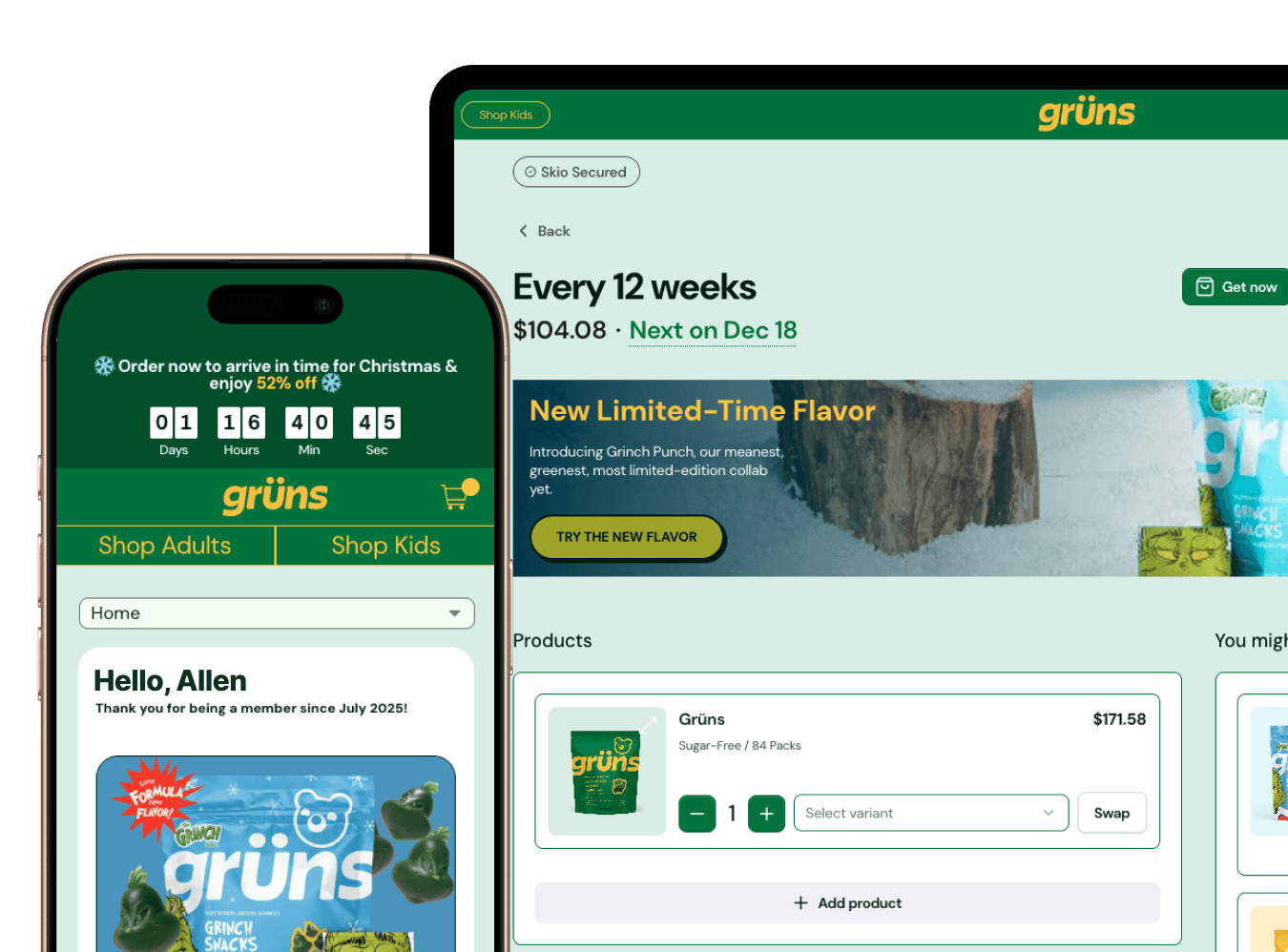
Skio’s Loyalty Credits are designed as native store currency: deposited automatically based on triggers you configure, visible in the Customer Portal, and redeemable at checkout via a Shopify extension. This isn’t a workaround—it’s infrastructure built for the way subscription customers actually shop.
Why Credits Outperform Discounts: The Psychological Difference
The behavioral economics here are well-documented, and they explain why credits consistently outperform discounts even when the dollar amounts are equivalent.
Mental accounting separates gains from savings. Customers mentally categorize a $10 credit as a gain—something added to their account. A 20% discount is processed as avoiding a loss, which activates different cognitive responses. Gains feel better than equivalent savings, even when the math is identical.
Discounts signal mispricing; credits signal appreciation. When you offer a discount, customers read it as “the price was negotiable.” When you offer a credit, customers read it as “the brand is rewarding my loyalty.” These are fundamentally different brand signals with very different long-term effects on perceived value.
Credits create forward momentum; discounts create hesitation. A customer with credits in their account is thinking “what should I buy?” A customer who just received a discount code is thinking “should I use this now or wait for a better offer?” Credits pull customers toward a purchase; discounts often delay decisions.
The endowment effect makes credits feel owned. Once a credit is deposited into an account, customers feel a sense of ownership over it. This psychological ownership increases the likelihood they’ll spend it—loss aversion now works in your favor, because spending the credit before it expires feels better than letting it go unused.
Credits don’t anchor future pricing expectations. Percentage-off offers set a reference price. Once a customer has received 20% off twice, they start wondering why they’re paying full price. Credits don’t create this anchoring problem because they’re additive, not subtractive.
Credits trigger gain-framed psychology (reward) while discounts trigger loss-framed psychology (price correction), making credits feel more valuable even at equivalent dollar amounts.
For a full breakdown of the psychology behind why dollar credits work so effectively as loyalty currency, see our companion post on behavioral framing in loyalty programs. If why cash back outperforms percentage-off as a retention mechanism interests you from a financial modeling perspective, that piece goes deeper on the revenue math.
Performance Data: Credits vs. Percentage-Off in Real Subscription Programs
The psychological framing is compelling, but Champions need numbers. Here’s what the data shows when brands make the switch from percentage-off to credits.
Redemption rates: Brands using credits see 18-25% higher redemption rates than equivalent percentage-off offers. Customers redeem credits within 30 days 68% of the time, compared to 45% for discount codes. The higher urgency—especially with expiration windows—and the “found money” feeling drive faster action.
AOV on redemption orders: This is the number that tends to surprise people. AOV on credit redemption orders averages 30-40% higher than baseline because customers actively shop to maximize credit value. When you have $10 in credits, you’re not buying the minimum—you’re thinking about what else you can add.
Credits drive 18-25% higher redemption rates and 30-40% higher AOV compared to percentage-off offers because customers add products to maximize credit value.
Cancel flow recovery: Credit-based cancel flows recover 12-15% more subscribers than discount-based flows. This is partially psychology (credits feel like a reward, not a desperation offer) and partially mechanics (credits don’t require an immediate purchase decision, which reduces the pressure that causes some customers to cancel anyway).
Long-term behavior: This is the metric that matters most for margin health. Customers who receive credits don’t escalate their expectations over time the way discount recipients do. Repeat credit recipients don’t demand higher amounts—the reward stays fresh because it’s positioned as loyalty recognition, not a price negotiation.
Credits Drive Add-On Revenue (Discounts Don’t)
A customer with $10 in credits and a $30 subscription renewal is not thinking about their subscription. They’re thinking about what else they can buy.
This is the add-on revenue dynamic that makes credits genuinely different from discounts as a business tool. A 20% discount on a $30 order saves the customer $6 and costs you $6. A $10 credit on a $30 order often results in a $45-50 total order because the customer adds products to “use up” the value. Your cost is $10; your incremental revenue is $15-20.
Credits turn retention incentives into revenue drivers, not just cost centers.
Here’s a concrete example: a subscriber has $10 in credits applied to their monthly $30 renewal. While in the portal, they see a one-time add-on product for $15—something they’ve been curious about but haven’t tried. With $10 already applied, the effective cost of the add-on feels like $5. They add it. You’ve just generated $15 in revenue you’d never have seen with a percentage-off offer. Credits make customers shop your catalog; discounts make them buy the minimum to capture the deal.
Skio’s one-time upsell functionality is purpose-built for this behavior. When a customer is in the Customer Portal redeeming credits, you can surface relevant one-time products alongside their subscription. The credit creates the shopping mindset; the upsell captures the intent.
When to Use Credits vs. Discounts: A Decision Framework
Credits are not the right tool for every situation. Use this framework to make the call.
Scenario | Use Credits | Use Percentage-Off | Why |
|---|---|---|---|
Cancel flow intervention | ✓ | Credits don’t train discount-seeking behavior; discounts signal desperation | |
Milestone rewards (5th order, 1 year) | ✓ | Feels like earning something, not getting a sale | |
Referral rewards | ✓ | Flexible spending drives higher redemption across catalog | |
Acquisition (first-order discount) | ✓ | New customers expect discounts; no loyalty relationship to protect yet | |
Failed payment recovery | ✓ | Removes friction without devaluing the product | |
Seasonal promotion (Black Friday) | ✓ | Market expectation is percentage-off; credits feel complicated in a sale context | |
Skip flow intervention | ✓ | Rewards customers for staying engaged rather than rewarding skipping | |
Winback (lapsed subscribers) | ✓ | Credits feel like a fresh start; discounts feel like a clearance sale |
The pattern: use credits whenever you’re trying to build or reinforce a loyalty relationship. Use percentage-off when market context sets the expectation—acquisition, seasonal sales—where customers are comparison shopping and a clear price signal matters more than brand building.
How to Implement Credits Without Killing Margin
Credits are not free money. Every credit you deposit is a liability until it’s redeemed—and if you’re not managing redemption behavior, you can create real financial exposure. Here’s how to protect margin while still making credits feel generous.
Set credit caps per account per period. A maximum of $15 in credits per quarter prevents compounding liability for high-frequency customers and keeps total exposure predictable. Model this against your subscriber base before you launch.
Use expiration windows to create urgency. 60-90 days is the sweet spot. Short enough that customers act; long enough that it doesn’t feel punitive. Credits that expire in 30 days feel pressured; credits that never expire pile up as liability and often go unused. See our guide on using expiration to create urgency for specific expiration window strategies.
Restrict credits to full-price items. Allowing credits on already-discounted products creates double-dipping that destroys margin. Skio lets you configure product restrictions so credits can’t be applied to sale items.
Tier credit amounts by subscriber LTV. A customer on their 12th order should receive a more valuable credit than someone on their second. This costs you more with your best customers, but those customers also generate the most lifetime revenue. Tiering also makes the reward feel earned rather than automatic.
Track incremental revenue per credit issued. Your goal is 3-5X return on each credit—if you issue $10 in credits, you should be seeing $30-50 in order value on redemption. If you’re not hitting that ratio, adjust the credit amount, improve communication, or tighten the expiration window.
For a comprehensive approach to how to protect margin with credit guardrails, including financial modeling templates and redemption rate benchmarks, see our dedicated guide on margin-safe loyalty design.
Real Examples: Brands Using Credits to Drive Retention
The cancel flow replacement: One brand replaced their standard 20% off cancel flow offer with a $10 store credit—same dollar value, different format. Recovery rate jumped 14%. AOV on recovered orders increased 28% because customers who accepted the credit came back and added products. Total revenue per recovered subscriber increased significantly even though the intervention cost stayed the same.
Milestone credits and LTV: Another brand introduced credits at order milestones—$5 at order 3, $10 at order 6, $15 at order 12. LTV of customers who received milestone credits was 2.1X higher than non-recipients. Some of that is selection bias (customers who reach order 12 are already good customers), but cohort analysis showed the credits themselves contributed to higher retention between milestones. For context on structuring milestone programs, progressive discount strategies offer a related framework you can adapt for credit-based programs.
Failed payment recovery: A third brand tested $5 credits as the incentive for customers to update failed payment information, replacing the standard “your subscription has a problem” transactional email. Ninety percent of credited customers redeemed within 14 days; 35% added a product to their recovery order. The credit created a reason to engage with the brand again rather than just fix an administrative problem.
The common thread across all three: credits created shopping behavior. Discounts created transactional behavior. Shopping behavior builds brands; transactional behavior erodes them.
How to Track Credit Performance (Metrics That Matter)
Track credit ROI the same way you’d track any revenue program: with specific metrics and a control group. These are the numbers that matter.
Redemption rate: Percentage of credited customers who actually spend the credit. 68%+ within 30 days is strong. Below 50% means your communication or expiration window needs work.
Time to redemption: Days between credit deposit and use. Shorter is generally better—fast redemption means the credit created urgency and drove immediate action.
AOV lift: Average order value on credit redemption orders compared to your baseline subscription order. You’re looking for 30-40% lift. If you’re not seeing it, customers may not be aware they can add products.
Incremental revenue per credit: Total order value on redemption orders minus the credit amount. Target 3-5X the credit value. A $10 credit should drive $30-50 in orders.
Retention impact: Churn rate of credited customers versus a matched control group over 90 days. This is the number that proves the program works to leadership.
Credit liability: Outstanding credit balance at any given time. Watch for this number growing—if credits are piling up unredeemed, adjust your expiration window or improve communication.
Track credit ROI by measuring redemption rate, time to redemption, AOV lift, incremental revenue per credit, and retention impact against a control group.
Skio’s Loyalty Analytics dashboard tracks redemption rate, outstanding balance, and revenue impact in one place. This is how you build the internal case for expanding the program—bring leadership a slide showing 3.8X return on credits issued, and the conversation about budget gets much easier.
Common Mistakes Brands Make with Subscription Credits
Most credit programs that underperform do so because of avoidable execution mistakes.
Issuing credits too frequently. Weekly or monthly credits dilute the reward signal. Credits should feel meaningful, not automatic. Quarterly milestone credits or event-triggered credits (cancel flow, referral) maintain that sense of occasion.
No expiration window. Credits without expiration pile up as accounting liability and often go unused because there’s no urgency. Always set an expiration.
Poor communication about credit balance. The most common reason for low redemption rates: customers don’t know they have credits. Email reminders, Customer Portal balance visibility, and expiration warnings are all required. Integrate with Klaviyo to send automated credit balance and expiration notifications.
Allowing credits on discounted items. This is the margin leak most brands discover after the fact. Configure product restrictions before you launch.
Not measuring redemption behavior. If you’re not tracking redemption rate and AOV lift, you can’t prove the program works—and you can’t fix it when it doesn’t. Set up your analytics before you turn on credits, not after.
Setting Up Credits in Skio: Technical Overview
Skio’s Loyalty Credits are built as native store currency—not a points conversion, not a discount code workaround. Here’s how the infrastructure works.
Credits are deposited into customer accounts automatically based on triggers you configure: cancel flow saves, order milestones, referrals, or manual grants for specific customers. The balance is visible to customers in the Customer Portal, so they always know what they have available.
At checkout, customers apply credits via a Shopify checkout extension—a native block that shows their balance and applies it with one click. No code to copy, no friction, no reason not to use it. This is why credit redemption rates are materially higher than discount code redemption rates: the mechanics match the psychology.
You can configure expiration rules, maximum balances, and product restrictions directly in the Loyalty Credits setup. Klaviyo integration lets you trigger automated emails when credits are deposited, when balances are about to expire, and when customers have unredeemed credits sitting in their account.
The analytics layer tracks everything: credits issued, credits redeemed, outstanding balance, and revenue generated on redemption orders. If you’re used to running retention programs without clear ROI visibility, this is a meaningful change.
What to Do Next: Testing Credits in Your Retention Strategy
The fastest way to prove this works for your brand is a focused A/B test in your cancel flow.
Set up two cancel flow variants: one offering $10 in store credit, one offering 20% off the next order. Split traffic 50/50 and run for at least 30 days or 200 cancel attempts, whichever comes first.
Measure three things: recovery rate (which flow saves more subscribers), redemption rate (do customers actually use the credit), and AOV on recovered orders (are credit recipients spending more?).
If credits win, expand the program. Add credits to your skip flow, failed payment recovery sequence, and order milestone triggers. Credits work best as a consistent system, not a one-off test.
Set up Klaviyo flows to notify customers when credits are deposited and when they’re about to expire. Customers who don’t know they have credits don’t spend them. Running credit-based campaigns through Klaviyo is one of the highest-ROI uses of your email program.
Track credit liability monthly. If your outstanding balance is growing and redemption rate is below 50%, shorten your expiration window or improve your communication cadence. Credits that don’t get spent don’t drive retention—they just create accounting complexity.
Skio’s Cancel Flow settings support A/B testing natively, so you can run this experiment without any custom development. Configure both flows, set your traffic split, and let the data tell you what works for your customers.
The brands that have made this shift consistently report the same outcome: credits recover more subscribers, those subscribers spend more when they come back, and the program pays for itself many times over. The test takes 30 days. The data is straightforward. Run it.
Frequently Asked Questions
Do subscription credits work better than percentage-off discounts for retention?
Yes. Credits drive 18-25% higher redemption rates and 30-40% higher AOV because they feel like rewards, create spending flexibility, and don’t train customers to expect discounts. The behavioral economics are clear: credits trigger gain-framed psychology while discounts trigger loss-framed psychology, making credits feel more valuable even at equivalent dollar amounts.
How do I prevent subscription credits from hurting my margins?
Set credit caps per account per quarter, use 60-90 day expiration windows, restrict credits to full-price items, and tier credit amounts by subscriber LTV. Track AOV lift on redemption orders—your target is 3-5X the credit value in total order revenue. Credits structured this way are revenue-positive, not cost centers.
When should I use percentage-off discounts instead of credits?
Use percentage-off for acquisition (first-order discounts where new customers are comparison shopping) and seasonal promotions where the market expectation is a sale. Use credits for retention, milestones, referrals, and failed payment recovery—any context where you’re trying to reinforce a loyalty relationship rather than compete on price.
How long should subscription credits be valid before expiring?
60-90 days is the standard that balances urgency with customer-friendliness. Shorter windows (30 days) create urgency but can feel punitive. Longer windows (6+ months) feel generous but increase unredeemed credit liability. If redemption rates are low, shorten the window and improve communication before extending it.
Can subscription credits be used on one-time purchases or just subscriptions?
Credits work best when redeemable across your entire catalog—subscription renewals and one-time products alike. Cross-catalog redemption is what drives the 30-40% AOV lift: customers who can spend credits on anything tend to add products they wouldn’t have bought otherwise. Restricting credits to subscription orders only limits this behavior.
What’s a good redemption rate for subscription credits?
68% redemption within 30 days is strong performance. If you’re below 50%, the fix is almost always communication: customers don’t know they have credits, don’t know when they expire, or don’t see them prominently enough in the Customer Portal. Improve your Klaviyo notification cadence and ensure credit balance is visible on the Customer Portal home screen before adjusting anything else.